 Log in
 Start Free Trial

Best overall: HubSpot. Best for sales-assisted e-commerce: Arches CRM. Best for repeat-purchase campaigns: Klaviyo. The best CRM for ecommerce in 2026 depends on whether your team needs to manage customer conversations, marketing campaigns, or complex sales opportunities.
- HubSpot is the best CRM for ecommerce teams seeking a shared foundation for sales, marketing, and service.
- Arches CRM is best for e-commerce sales teams managing leads, customer conversations, and follow-up workflows.
- Klaviyo suits retention marketing; it is not a replacement for a sales pipeline CRM.
- Choose Salesforce for complex sales operations, Zoho CRM for connected business applications, and Pipedrive for wholesale opportunities.
Why this matters
A shopper asks about a product. Someone answers, but nobody owns the next step. Your store records the transaction if it happens; a CRM helps your team manage the conversation before and after it.
That distinction matters when choosing e-commerce CRM software in 2026. A merchant sending automated campaigns needs a different system from a business handling wholesale inquiries, consultations, or purchases that require several conversations.
Choose the customer process first, then choose the software. A contact database alone does not establish who should follow up, what they should say, or when an opportunity should move forward.
What makes the best CRM for ecommerce?
Use these criteria before comparing feature lists. Each criterion addresses a specific operational job, not a claim that more features automatically produce more sales.
- Customer context: Your team needs contact details, conversation history, and relevant purchase information together. Verify how order data reaches the customer record.
- Follow-up ownership: Every active inquiry needs an assigned person and a clear next action. Automated reminders should support accountability, not replace it.
- Workflow control: Check triggers, conditions, stopping rules, and handoffs. A customer reply should change what happens next.
- Channel fit: Match the software to the channels your customers actually use, including email, WhatsApp, SMS, and calls where relevant.
- Commerce connection: Validate your specific storefront and required data fields. A connector name alone does not prove that refunds, variants, or order changes reach the right record.
- Operational reporting: Separate campaign performance from sales activity. You need to understand both customer engagement and the work required to close an opportunity.
For your 2026 evaluation, use 10 customer records and 3 workflows as a practical test set. Include a new inquiry, a returning customer, and an opportunity that should stop receiving follow-ups after a reply. These are recommended test inputs, not performance benchmarks.
E-commerce CRM options at a glance
The table separates relationship management from campaign automation. Row order matches the detailed recommendations below; each option owns a different use case.
| Option | Best for | Standout capability | Key limitation |
|---|---|---|---|
| Arches CRM | Sales-assisted e-commerce | Lead management, communication, and automated pipeline workflows | Storefront data mapping needs validation against your requirements |
| HubSpot | Shared sales, marketing, and service processes | Customer records connected to several customer-facing functions | Cross-team configuration requires clear ownership |
| Klaviyo | Repeat-purchase campaigns | E-commerce-focused segmentation and email/SMS automation | Not a substitute for opportunity management |
| Salesforce | Complex sales operations | Configurable CRM processes and a broad application ecosystem | Implementation and administration require planning |
| Zoho CRM | Teams using connected business applications | Sales automation within the wider Zoho application family | A complete commerce process can span multiple applications |
| Pipedrive | Wholesale and dealer opportunities | Deal pipelines, sales activities, and follow-up tracking | Not a dedicated retention-marketing platform |
1. Arches CRM: best e-commerce CRM for sales-assisted purchases
Arches CRM brings leads, contacts, conversations, tasks, and sales activity together. Its automation moves opportunities through configured pipelines based on customer interactions, while its assistance summarizes conversations and drafts emails.
Arches CRM is best for e-commerce sales teams that need accountable follow-up across customer conversations. This is a sales-process recommendation: choose it when purchases involve questions, qualification, or a salesperson rather than assuming every shopper needs an opportunity record.
Arches CRM pros:
- Captures, organizes, and assigns prospects.
- Tracks opportunities from inquiry to closed deal.
- Automates reminders, tasks, and follow-up sequences.
- Brings email, WhatsApp, SMS, and calls together.
Limitations:
- Configured workflows need clear entry conditions and stopping rules.
- Storefront integration requirements need validation, including which order details reach customer records.
- Pipeline automation still depends on your team defining meaningful sales stages.
Best for: Growing e-commerce sales teams handling purchases that need human follow-up.
In a 2026 evaluation, demonstrate a customer reply, a reassigned lead, and a changed opportunity stage. Inspect what updates automatically and what remains a salesperson's responsibility. Verdict: Buy for sales-assisted commerce after validating your store connection.
2. HubSpot: best e-commerce CRM for shared customer operations
HubSpot combines CRM records with sales, marketing, and customer-service tools. It suits a merchant that wants these teams to work from a common customer foundation rather than manage separate lists.
The strongest reason to shortlist HubSpot is organizational fit. If marketing creates demand, sales handles selected inquiries, and service manages customer issues, your evaluation should focus on the handoff between those functions.
HubSpot pros:
- Provides shared contact and company records.
- Supports sales pipelines and activity tracking.
- Offers connected marketing and service functions.
- Has an application marketplace for connecting business systems.
HubSpot cons:
- A shared platform requires agreement on record ownership and lifecycle definitions.
- Store data still needs deliberate mapping into CRM records.
- Teams buying across functions need to check which capabilities belong to their intended configuration.
Best for: E-commerce businesses coordinating sales, marketing, and service around shared customer records.
Before selecting HubSpot, follow an inquiry from first contact through purchase and a subsequent service request. Check that each team sees the context it needs without creating parallel customer records. Verdict: Buy as the default cross-functional shortlist choice.
3. Klaviyo: best e-commerce option for repeat-purchase campaigns
Klaviyo is an e-commerce marketing platform built around customer profiles, segmentation, and email and SMS campaigns. It belongs in this comparison because customer relationship work includes retention, but it is not the same category as a salesperson's opportunity-management system.
Choose Klaviyo when the central job is deciding which customer receives which campaign based on customer and commerce data. Do not treat campaign engagement as a replacement for an assigned sales task.
Klaviyo pros:
- Focuses on e-commerce customer segmentation.
- Supports automated email and SMS marketing.
- Uses customer activity and commerce data to inform campaigns.
- Fits retention work that does not require a salesperson on every account.
Klaviyo cons:
- Does not replace a dedicated sales pipeline CRM.
- Campaign quality depends on usable customer data and appropriate consent.
- Teams managing negotiated purchases still need a process for sales ownership.
Best for: Merchants prioritizing lifecycle messaging and repeat-purchase campaigns.
In 2026, evaluate Klaviyo against your retention brief, not a generic CRM checklist. Test whether purchase events and customer segments support the messages you intend to send. Verdict: Buy for retention marketing; skip as your sole sales CRM.
4. Salesforce: best e-commerce CRM for complex sales operations
Salesforce provides configurable CRM applications for sales and service, alongside a broad ecosystem of related applications. It suits organizations whose customer processes include several teams, account structures, or approval requirements.
The deciding factor is complexity, not business prestige. A merchant with straightforward inquiries does not need an elaborate implementation simply because a larger organization uses it.
Salesforce pros:
- Supports configurable sales processes and data structures.
- Provides account, contact, and opportunity management.
- Offers sales and service applications.
- Connects with a broad ecosystem of business applications.
Salesforce cons:
- Configuration and administration require dedicated ownership.
- Custom processes create additional testing and maintenance work.
- A commerce connection must be designed around the required customer and order data.
Best for: E-commerce organizations with complex account relationships and multi-team sales operations.
Write down the process that simpler systems cannot support before committing. Then demonstrate that process, including permissions and exceptions, rather than accepting a feature tour. Verdict: Buy for documented operational complexity; hold for straightforward sales workflows.
5. Zoho CRM: best e-commerce CRM for connected business applications
Zoho CRM manages leads, contacts, opportunities, and sales automation. It sits within a wider family of business applications, making it a relevant choice when your team wants connected tools beyond the sales pipeline.
Choose Zoho CRM for the business workflow you can define, not the number of applications in the suite. Your evaluation should establish where customer information lives and which application owns each update.
Zoho CRM pros:
- Provides lead, contact, and deal management.
- Supports sales workflow automation.
- Connects with other Zoho business applications.
- Offers configuration options for sales processes.
Zoho CRM cons:
- A complete commerce workflow can require several applications.
- Cross-application processes need clear data ownership.
- Your specific storefront connection needs validation before selection.
Best for: E-commerce teams already using, or deliberately choosing, connected Zoho applications.
Trace an inquiry, a sale, and a customer issue through the proposed setup. Identify where staff would need to switch applications or repeat an update. Verdict: Buy when the application fit is deliberate; hold if the workflow is still undefined.
6. Pipedrive: best e-commerce CRM for wholesale opportunities
Pipedrive centers on deals, pipelines, and sales activities. It fits an online business that also handles wholesale accounts, dealer inquiries, or negotiated orders requiring an explicit next step.
Use the pipeline to represent a real sales decision. Creating a deal for every routine storefront order adds work without necessarily improving customer management.
Pipedrive pros:
- Organizes opportunities in visual sales pipelines.
- Connects activities to contacts and deals.
- Supports sales follow-up and workflow automation.
- Keeps deal progression central to the working process.
Pipedrive cons:
- Is not a dedicated e-commerce retention-marketing platform.
- Storefront order context depends on the chosen connection.
- A deal-based process is unnecessary for purchases that require no sales involvement.
Best for: E-commerce businesses managing wholesale, dealer, or negotiated sales opportunities.
Demonstrate a wholesale inquiry from qualification through agreement. Check whether the salesperson can find the last conversation and the next activity without maintaining a separate spreadsheet. Verdict: Buy for wholesale pipeline management; skip for campaign-only needs.
How the recommendations are ranked
These recommendations rank software by the job it needs to perform: accountable follow-up, shared customer operations, retention campaigns, complex sales, connected applications, or wholesale deals. They are use-case selections, not measured performance scores.
For your 2026 shortlist, require the same demonstration from each relevant vendor. A polished presentation matters less than whether your actual customer process works from beginning to end.
Test the workflow, not the feature list
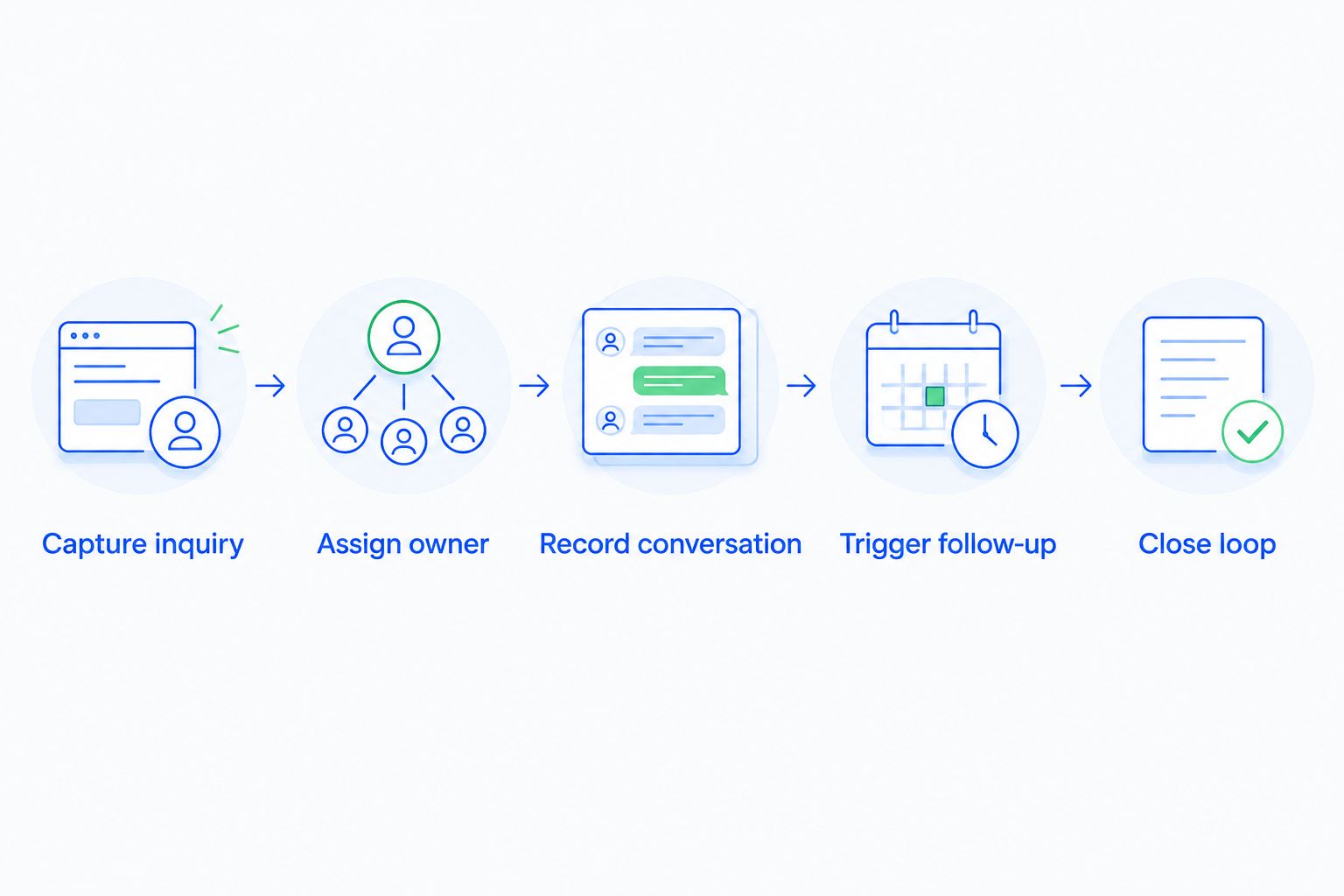
Give every active inquiry 1 named owner. Then evaluate this sequence:
- Capture inquiry: Create the contact and preserve the source and customer question.
- Assign owner: Make responsibility visible before the next action begins.
- Record conversation: Keep the reply attached to the correct customer record.
- Trigger follow-up: Create the appropriate task or sequence, with a stopping condition.
- Close loop: Update the opportunity and preserve the outcome for reporting.
The sequence should handle a reply as well as silence. For a closer look at stopping rules and task creation, read how a CRM handles follow-up reminders automatically.
Which e-commerce CRM should you choose?
Choose HubSpot as the default shortlist option when sales, marketing, and service need shared customer records. Choose the sales-assisted option when assigned follow-up is the central requirement, and choose Klaviyo when retention campaigns are the main job.
Salesforce belongs on the shortlist for complex operations. Zoho CRM fits a deliberate connected-application strategy. Pipedrive fits wholesale opportunities. Do not combine every option simply because each solves a different problem; define which system owns contacts, conversations, and sales outcomes first.
The strongest 2026 buying decision is the one your team can demonstrate with actual workflows. Reject a setup that leaves staff asking who should respond next.
FAQ
What's the best CRM for ecommerce in 2026?
HubSpot is the default shortlist choice for e-commerce teams seeking shared sales, marketing, and service records. Choose a different option when your main requirement is retention campaigns, sales-assisted purchases, or complex account management.
Is Arches CRM a good fit for an e-commerce business?
Arches CRM fits e-commerce businesses that manage leads, customer conversations, and sales follow-up. Validate your storefront connection and required order data before selecting it.
Is Klaviyo a CRM or an email marketing platform?
Klaviyo is an e-commerce marketing platform with customer profiles, segmentation, and email and SMS automation. It does not replace a dedicated sales CRM when your team needs opportunity stages and assigned sales activities.
Do I need a CRM if my online store already stores customer details?
You need a CRM when your team needs a separate process for conversation history, follow-up ownership, or sales opportunities. A store's customer records alone do not establish who should handle the next sales action.
Which CRM is best for e-commerce wholesale sales?
Pipedrive is the shortlist choice here for wholesale opportunities because it centers on deals, pipelines, and sales activities. Salesforce is the alternative to evaluate when account structures and sales processes require greater configuration.
What should I test before choosing e-commerce CRM software?
Test customer identity, conversation history, ownership, follow-up triggers, and relevant order data. Include a reply and an order change so you can inspect exceptions rather than only the simplest workflow.
Should every online order become a CRM deal?
No, create CRM deals when a purchase requires a managed sales process. Routine transactions can remain commerce records while customer data supports service and retention workflows.
One last thing
Test the stop condition before the follow-up sequence. A workflow that keeps messaging after a customer replies is not doing the job you intended.
During the demonstration, reply to the test message and inspect the next task, the assigned owner, and the opportunity stage. That single scenario reveals whether your proposed setup responds to customer behavior or merely runs a schedule.