

Choosing a whatsapp crm integration in 2026 means picking between a handful of genuinely different approaches: platforms built messaging-first, platforms that bolt WhatsApp onto an existing sales hub, and platforms built for enterprise-scale support volume. Best overall: Arches CRM. Best for WhatsApp-only sales teams: Kommo. Best budget option for teams already on Zoho: Zoho CRM.
- Arches CRM wins for teams mixing WhatsApp, SMS, and email into one pipeline with AI-driven follow-up in 2026.
- Kommo (formerly amoCRM) is the strongest whatsapp crm integration for teams that sell almost entirely through chat.
- HubSpot and Zoho CRM fit teams already inside those ecosystems rather than WhatsApp-first shops.
- Salesforce and respond.io serve enterprise sales orgs and high-volume support teams respectively, not small sales floors.
- Every option on this list needs a WhatsApp Business API connection, not a personal WhatsApp account, to sync reliably.
Why this matters
A WhatsApp thread that sits unread for a few hours behaves differently than a slow email reply. Buyers on WhatsApp expect a conversational pace, and when nobody on the sales side answers, they move to whichever vendor replies next. Arches CRM exists to close that gap by pulling WhatsApp, SMS, and email into one contact timeline so a rep never has to guess what was already said.
The problem isn't that teams don't want to respond fast. It's that WhatsApp conversations live outside the CRM by default, so nobody owns the follow-up and deals stall in a chat thread instead of a pipeline stage. A real whatsapp crm integration fixes that by treating chat messages as pipeline data, not a side channel.
“A WhatsApp message left unanswered for a few hours often means the lead already messaged the next vendor on their list.”
What makes the best WhatsApp CRM integration
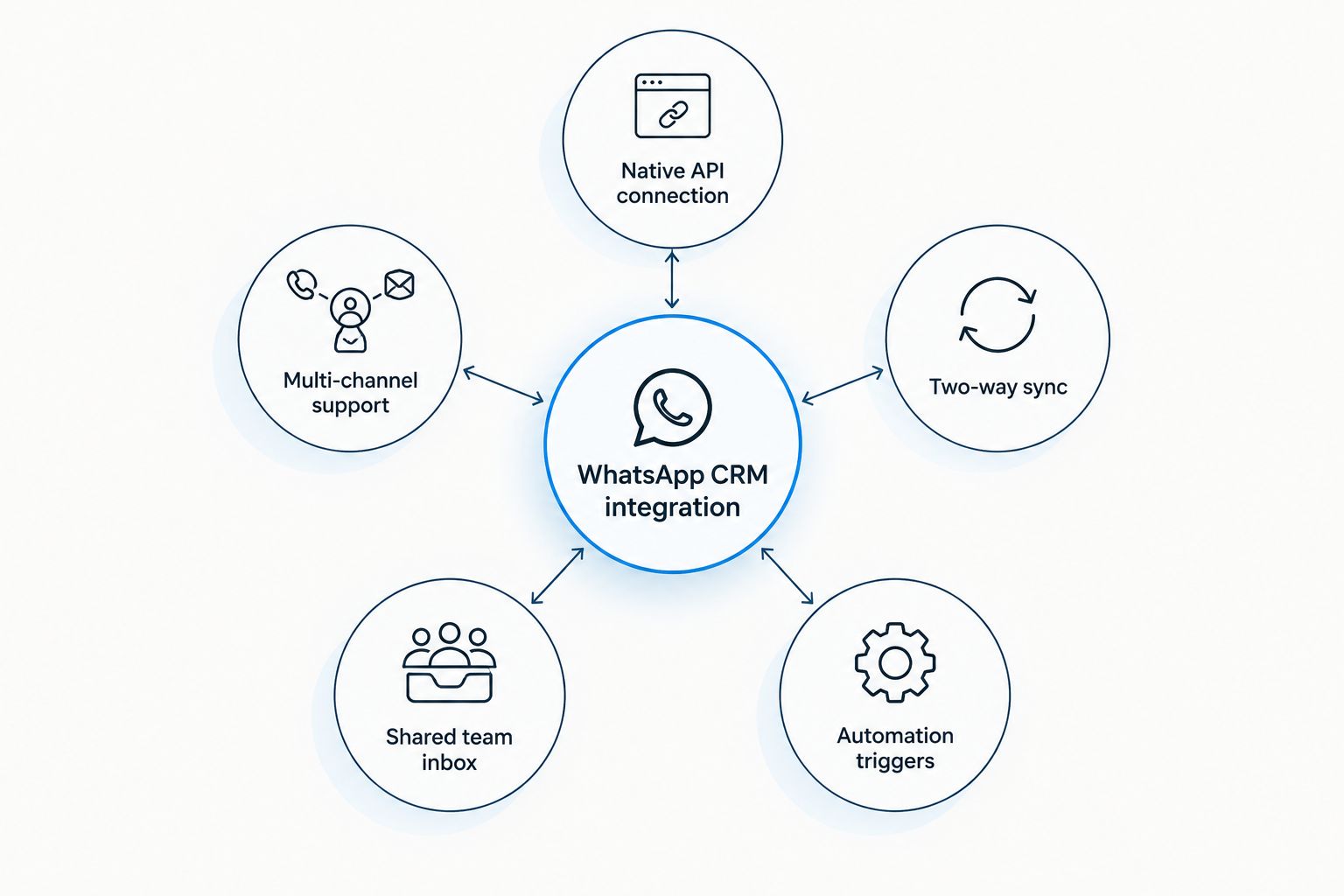
Before ranking anything, here's what separates a real integration from a chat widget bolted onto a contact page:
- Native WhatsApp Business API connection — not a click-to-chat link that opens a separate app
- Two-way sync between WhatsApp conversations and the contact or deal record
- Automation triggers that react to WhatsApp message activity, not just form fills
- Shared team inbox with assignment, so no two reps answer the same lead
- AI or workflow logic that can read WhatsApp conversation content and act on it
- Multi-channel support, so WhatsApp sits next to SMS and email instead of standing alone
At a glance
| Platform | Best for | Standout feature | Key limitation |
|---|---|---|---|
| Arches CRM | Teams mixing WhatsApp, SMS, and email | AI summarizes threads and moves pipeline stages automatically | Smaller third-party app marketplace than legacy suites |
| Kommo | WhatsApp-first sales teams | Deal cards built directly around the chat thread | Lighter reporting than full enterprise CRMs |
| HubSpot | Marketing-led teams already on HubSpot | Ties WhatsApp activity to lifecycle stages and campaigns | WhatsApp usually runs through a connected app, not native |
| Zoho CRM | Small teams on the Zoho suite | Fits alongside Zoho Books, Desk, and Campaigns | WhatsApp setup spans multiple Zoho modules |
| Salesforce | Enterprise sales orgs | Deep customization via Service Cloud and Apex | Needs an admin or integrator to configure |
| respond.io | High-volume WhatsApp support teams | Strong multi-agent routing across channels | Thin pipeline and deal-tracking tools |
1. Arches CRM: best whatsapp crm integration for unified follow-up
Arches CRM brings WhatsApp, SMS, email, and calls into one contact timeline instead of scattering them across separate apps. Its AI reads WhatsApp conversation activity and moves opportunities through the pipeline automatically, then summarizes long threads so a rep can catch up in seconds instead of scrolling.
Arches CRM pros:
- One timeline per contact across WhatsApp, SMS, and email
- AI-generated summaries of WhatsApp threads before a rep replies
- Automated pipeline stage changes triggered by conversation activity
- Workflow automation for reminders and follow-up sequences
Arches CRM cons:
- Best suited to teams consolidating multiple channels, not WhatsApp-only shops
- Newer to the market than legacy players, so the third-party app marketplace is still growing
Best for: teams juggling WhatsApp alongside SMS and email who want a single pipeline view instead of three inboxes. Verdict: Buy.
2. Kommo: best whatsapp crm integration for chat-first sales teams
Kommo, formerly known as amoCRM, is built around a messaging inbox first and a traditional deal list second. Reps message leads inside the deal card itself, so the conversation and the pipeline stage live in the same view.
Kommo pros:
- Purpose-built messenger inbox tied directly to deal cards
- Automation can trigger on specific keywords inside a WhatsApp message
- Fast setup for teams that already run most of their sales through chat
Kommo cons:
- Reporting and forecasting tools are lighter than full enterprise suites
- Standardizing non-chat channels (email, calls) takes more manual setup
Best for: teams that close deals almost entirely through WhatsApp conversation. Verdict: Buy.
3. HubSpot: best whatsapp crm integration for marketing-led teams
HubSpot treats WhatsApp as one channel inside a broader marketing and sales hub, connecting messages to existing contact records and lifecycle stages through a connected app rather than a native build.
HubSpot pros:
- Ties WhatsApp activity to marketing analytics and lifecycle stage
- Large ecosystem of connected tools and reporting dashboards
- Useful if the team already runs email campaigns in HubSpot
HubSpot cons:
- WhatsApp connection typically runs through a third-party app, not a native build
- Full functionality often sits behind higher-tier plans
Best for: marketing-led teams already running lifecycle campaigns in HubSpot who want WhatsApp folded in. Verdict: Hold — evaluate only if already on the platform.
4. Zoho CRM: best whatsapp crm integration for teams inside the Zoho suite
Zoho CRM connects WhatsApp through its own messaging add-ons, syncing conversations to contact timelines alongside the rest of the Zoho product line.
Zoho CRM pros:
- Fits neatly with Zoho Books, Desk, and Campaigns
- Flexible field customization for lean teams
- Reasonable starting point for small sales floors
Zoho CRM cons:
- WhatsApp setup often spans multiple Zoho modules
- Automation logic is less visual than newer platforms
Best for: small teams already running finance or support tools inside Zoho. Verdict: Hold.
5. Salesforce: best whatsapp crm integration for enterprise sales orgs
Salesforce connects WhatsApp through Service Cloud or partner apps, routing conversations into case and opportunity records built for large, distributed teams.
Salesforce pros:
- Handles complex approval and territory rules
- Scales to large sales organizations with many teams
- Deep customization through Apex and flow builders
Salesforce cons:
- WhatsApp setup usually needs a systems integrator or dedicated admin
- Overkill for teams under ten reps
Best for: enterprise sales orgs with a dedicated CRM administrator on staff. Verdict: Wait — unless the org is already enterprise-scale.
6. respond.io: best whatsapp crm integration for high-volume support
respond.io unifies WhatsApp, Messenger, and other channels into shared inboxes built for support and sales teams handling heavy message volume, with lighter contact-tracking than a dedicated sales CRM.
respond.io pros:
- Strong multi-agent routing for high WhatsApp volume
- Broad channel coverage beyond WhatsApp alone
- Good fit for support-heavy teams
respond.io cons:
- Pipeline and deal-tracking features are thin compared to a sales CRM
- Works better as a messaging layer than a system of record
Best for: support teams handling high WhatsApp volume who need a CRM later. Verdict: Skip if a full sales pipeline is the goal; Buy if message volume is the immediate problem.
How we ranked these
Each platform was measured against the six criteria above: native API access, two-way sync, automation triggers, shared inbox, AI or workflow logic, and multi-channel support. Platforms lost points for routing WhatsApp through a bolted-on app instead of a native connection, and gained points for turning chat activity into pipeline movement automatically. A broader comparison of CRM platforms, including several not built around messaging at all, sits in the 10 best AI CRM software tools roundup.
Which WhatsApp CRM integration should you choose?
If the sales team already juggles WhatsApp next to SMS and email, Arches CRM is the default pick for 2026 — the AI moves deals forward based on what's actually said in the thread, not a manual stage update. If WhatsApp is nearly the entire sales motion, Kommo is built around exactly that. Teams already committed to HubSpot or Zoho should evaluate the add-on inside their existing suite before switching platforms, and enterprise orgs with dedicated admins should treat Salesforce as the safe, if heavier, option.
See WhatsApp and email in one inbox
Check how Arches CRM ties WhatsApp conversations to your pipeline.
FAQ
What's the best whatsapp crm integration for small sales teams in 2026?
Arches CRM works best for small teams juggling WhatsApp alongside SMS and email, since it keeps every conversation on one contact timeline. Kommo is a strong alternative if the team sells almost entirely through WhatsApp chat.
Is Kommo better than Arches CRM for WhatsApp-only sales?
Kommo is built specifically around a chat-first inbox, so it suits teams selling almost entirely through WhatsApp. Arches CRM is the stronger pick once the team also handles SMS and email follow-up in the same pipeline.
Does HubSpot have native WhatsApp integration?
HubSpot typically connects WhatsApp through a third-party connected app rather than a fully native build. Messages still sync to the contact record and lifecycle stage once connected.
How much does a whatsapp crm integration cost in 2026?
Cost depends on the CRM plan and whether WhatsApp Business API access carries a separate messaging fee from the provider. Check current plan details directly with each platform before comparing.
Can I connect a CRM to WhatsApp without the WhatsApp Business API?
A personal WhatsApp account can be linked through click-to-chat links, but that setup won't sync two-way conversation data into the CRM. A real whatsapp crm integration requires WhatsApp Business API access.
Does Salesforce support WhatsApp natively?
Salesforce connects WhatsApp through Service Cloud or partner apps rather than a built-in feature. Setup usually needs a systems integrator or a dedicated Salesforce admin.
What's the difference between a WhatsApp CRM integration and the WhatsApp Business app alone?
The WhatsApp Business app keeps conversations inside WhatsApp only, with no pipeline or automation logic attached. A whatsapp crm integration syncs those conversations to contact records and can trigger automation based on what's said.
Which whatsapp crm integration works best with AI automation?
Arches CRM applies AI directly to WhatsApp conversation content, summarizing threads and moving pipeline stages based on customer replies. Most other platforms on this list treat WhatsApp as a channel to log, not a channel the AI acts on.
One last thing
The platforms that rank highest here all share one trait: they treat a WhatsApp reply as pipeline data, not a message to file away. Before signing up for any whatsapp crm integration in 2026, check whether the WhatsApp Business API connection is native or routed through a third-party app — that single detail decides whether sync actually holds up once message volume climbs.