
 Log in
 Start Free Trial

An AI CRM identifies a lead as going cold by checking customer interactions, sales activity, and pipeline progress against the criteria used by its model or configured workflows. The useful signal is not silence alone: it is silence combined with an unanswered next step, stalled progress, or a change in the conversation. Treat the result as a reason to review the lead, not proof that the buyer has lost interest.
- How does AI CRM decide when a lead is going cold? It evaluates interactions and progress against configured criteria.
- Arches CRM suits growing sales teams that need customer conversations and follow-up workflows in one place.
- Lead scoring should distinguish buyer inactivity from a missed follow-up by your team.
- A cold-lead flag should trigger review and a relevant next action, not automatic rejection.
How does AI CRM decide when a lead is going cold?
An AI CRM evaluates recorded behavior in context. That context includes the opportunity's current stage, the customer's latest response, and the next action your team expected to happen. A message without a reply means something different from a missed meeting or an explicit request to pause.
The decision also depends on how the system is configured. Rules can flag a missed task or an overdue milestone; a scoring model can combine several signals; conversation analysis can help interpret what the buyer actually said. These approaches provide different kinds of evidence, not interchangeable proof of intent.
Start with the action behind the flag. A useful automatic follow-up reminder workflow connects a recorded event to an owner and a next step.
| Evidence to examine | What it tells you | What it does not establish |
|---|---|---|
| Last customer response | When the buyer last participated | Whether the buyer has rejected the offer |
| Unanswered next step | Whether an expected action remains incomplete | Whether the delay belongs to the buyer or your team |
| Pipeline movement | Whether the recorded opportunity has progressed | Whether the stage accurately reflects the conversation |
| Conversation content | Whether the buyer expressed interest, objections, or a pause | Whether an automated interpretation is correct |
| Activity across channels | Whether recorded email, messages, and calls show continuing contact | Whether unrecorded conversations happened elsewhere |
A cold-lead flag is an attention signal, not a lost-deal verdict. Your team still needs to inspect the evidence and choose the response.
Why this matters
A lead arrives. Someone starts a conversation, sends information, and waits. If nobody owns the next action, the opportunity sits in the pipeline without a clear explanation.
The wrong diagnosis creates the wrong response. Calling the buyer disengaged hides an overdue seller task; treating an explicit pause as ordinary silence produces unnecessary follow-ups. For your 2026 workflow review, separate customer behavior from team execution before you automate either.
A useful CRM process answers three practical questions: what happened, what should happen next, and who owns it. An alert without those answers adds another item to check rather than resolving the stalled conversation.
What information should support a cold-lead decision?
Customer interactions
Look at the customer's latest meaningful participation, not just the latest activity recorded on the contact. Your team's outgoing email is activity, but it is not evidence that the buyer remains engaged.
A reply explaining that approval is pending gives you a different next action from a reply declining the offer. Read the context. The presence of a response matters, but the response itself matters more.
Pipeline position
Evaluate the lead against the expectations of its current stage. An initial inquiry and an opportunity awaiting a decision should not share an undifferentiated definition of inactivity.
Before applying a stage-based rule, check that the stage is accurate. If the conversation advanced but the record did not, the system is evaluating an outdated picture of the opportunity.
Tasks and commitments
A missed commitment identifies the unfinished work. That commitment might belong to the seller, the buyer, or someone involved in the decision.
Keep those distinctions visible. If your salesperson promised to send information and has not sent it, the appropriate response is to complete that task—not classify the buyer as uninterested.
Conversation context
Email summaries can help your team review an opportunity, but a summary should support the decision rather than replace the underlying conversation. Check messages that contain objections, requested timing, or conditions for proceeding.
For your 2026 review checklist, require the reviewer to distinguish an explicit pause from unexplained silence. Both need a next action, but they do not justify the same message.
Connected activity
Review the channels where the customer actually communicates with your team. An unanswered email does not describe the whole relationship when a relevant call or message is also recorded.
Incomplete records limit the decision. Before acting on a cold-lead flag, check whether the opportunity history contains the interactions your team relies on to manage the sale.
Which decision method should your team use?
Use the method that fits the decision you need to make. A workflow rule is useful for an explicit operational condition; a scoring model is useful for prioritization; conversation review is useful for interpreting intent. None removes the need for accurate records.
| Approach | Best for | Strength | Limitation |
|---|---|---|---|
| Configured workflow rules | Clear tasks and stage conditions | You can connect the trigger directly to a defined action | A rigid rule can ignore relevant context |
| Model-based lead scoring | Prioritizing records for review | It can combine multiple inputs into an ordering | A score without an explanation is difficult to assess |
| Conversation-assisted review | Understanding objections and requested timing | It keeps the customer's words central to the decision | Summaries and interpretations still need verification |
Use configured rules for clear commitments and human review for ambiguous intent. If you use a model to prioritize leads, ask what evidence supports the priority before deciding how to contact the buyer.
Do not confuse a score with an instruction. A lower-priority lead might need a scheduled check-in, a corrected record, or no immediate outreach. The appropriate action comes from the reason behind the score.
How should you configure a cold-lead workflow?
Build the workflow around observable events and accountable actions. For a 2026 configuration review, test the complete path from the recorded interaction to the task your salesperson receives—not just whether an alert appears.
- Check interactions. Review the latest customer response and the relevant conversation history. Confirm that the record reflects what happened.
- Confirm stage. Check whether the opportunity's pipeline position matches the customer's current situation. Correct the stage before evaluating stalled progress.
- Check commitments. Identify the unfinished next step and who agreed to complete it. Separate seller delays from buyer delays.
- Assign action. Give the appropriate team member a specific task, such as reviewing an objection, sending promised information, or confirming timing.
- Review outcome. Record the response and reassess the opportunity. Do not leave the original cold-lead label untouched after new information arrives.
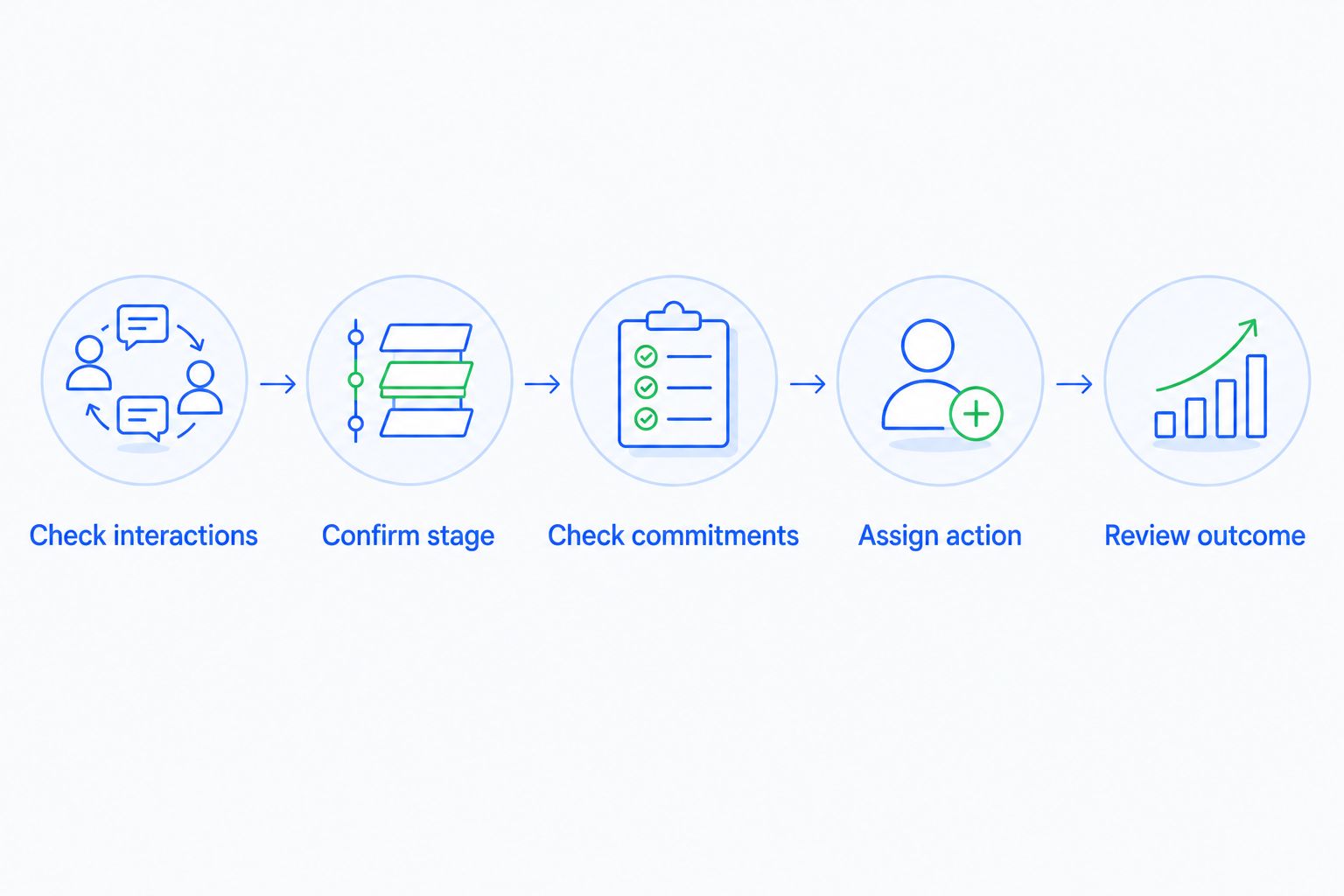
Keep the action specific enough to complete. A task to follow up leaves the salesperson to reconstruct the situation; a task to send the information promised in the last conversation identifies the actual work.
Define what resolves the flag, too. A new reply should prompt review of its meaning, not simply reset the record. A refusal, a request to wait, and an agreement to proceed require different outcomes.
Why cold-lead decisions vary
Cold-lead decisions vary because the expected next step varies. Use these factors to explain the decision rather than treating every quiet record as equivalent:
- Pipeline stage: Evaluate inactivity against the work expected at that stage, not against an unrelated opportunity.
- Customer's stated timing: A requested pause provides context that unexplained silence does not.
- Outstanding commitment: An incomplete seller task calls for action by your team before judging buyer interest.
- Recorded communication: Relevant email, WhatsApp, SMS, and call activity changes the evidence available for review.
- Configured workflow: The trigger and resulting task should reflect the process your team actually follows.
When revising your 2026 criteria, write down the reason for each trigger. If your team cannot explain why a condition deserves attention, do not let that condition drive an automatic customer message.
Avoid a single catch-all label for every delay. Keep an explicit pause, an unresolved objection, an overdue seller task, and unexplained inactivity distinguishable in your operating process.
Where does Arches CRM fit?
Arches CRM is best for growing sales teams that need customer conversations and follow-up workflows in one place. The platform organizes leads and contacts, tracks sales pipelines, and supports reminders, tasks, and follow-up sequences. Its AI moves opportunities based on customer interactions and configured workflows and summarizes email conversations.
That provides a practical foundation for reviewing stalled opportunities: your team can work from contacts, conversations, tasks, and sales activity rather than treating each as a separate record. The limitation remains the decision process itself—centralized information does not establish the buyer's intent or justify a specific cold-lead threshold.
Evaluate Arches CRM against a workflow your team can describe. Check how the relevant interaction, pipeline change, and follow-up task should connect; do not assume that automatic pipeline movement and cold-lead detection are the same feature.
A useful 2026 evaluation starts with a real operating question: can your team tell whether the opportunity needs a customer follow-up, an internal task, or a scheduled pause? Judge the workflow by that distinction, not by the presence of an AI label.
Does no reply mean a lead is going cold?
No reply is evidence of an unanswered conversation, not proof of lost interest. Check whether a response was expected, whether your team completed its promised action, and whether another recorded channel contains a relevant interaction.
If the next step is unclear, clarify it. Do not escalate an ambiguous silence into a rejection without evidence.
Should a CRM automatically mark a cold lead as lost?
A cold-lead flag should not automatically become a lost-deal decision. Use the flag to prompt review, then record the outcome that the conversation supports.
An explicit refusal supports a different decision from an agreed pause. Preserve that distinction so your pipeline reflects the customer's situation rather than the age of the record.
FAQ
How does AI CRM decide when a lead is going cold?
An AI CRM evaluates recorded customer interactions, sales activity, and pipeline progress against model criteria or configured workflows. Review the supporting evidence before treating the flag as a change in buyer intent.
How long should I wait before marking a lead cold?
Set the waiting period around the opportunity's stage, the customer's stated timing, and the agreed next step. Silence alone does not establish a universal deadline for marking a lead cold.
Can a lead be active even if they do not reply to email?
A lead can still be participating through another recorded channel, such as a call or message. Review the relevant conversation history before treating an unanswered email as disengagement.
Is AI lead scoring better than workflow rules?
AI lead scoring and workflow rules serve different purposes: scoring supports prioritization, while rules connect defined conditions to actions. Choose based on the decision you need to make and the evidence you can inspect.
Does Arches CRM automatically move opportunities through the pipeline?
Arches CRM automatically moves opportunities through the sales pipeline based on customer interactions and configured workflows. That capability does not by itself establish how a cold-lead label is calculated.
What should I do when a CRM flags a lead as going cold?
Review the latest conversation, confirm the pipeline stage, and identify the unfinished commitment before contacting the buyer. Assign a specific next action and update the opportunity after the outcome is known.
Should I send more automated messages to a cold lead?
Send a relevant next message only when the conversation and agreed timing support it. If the buyer requested a pause or your team owes information, address that situation instead of adding generic outreach.
One last thing
Before sending another follow-up, inspect the last promise your team made. The stalled opportunity might be waiting for your answer, not the customer's.
Make every cold-lead review end with an owner and a reasoned next action. If the only outcome is a new label, the workflow has classified the problem without resolving it.