 Log in
 Start Free Trial


Yes—a CRM can flag deals at risk of falling through by tracking stalled opportunities, missed follow-ups, and gaps in customer communication. In 2026, the useful distinction is between identifying warning signs and predicting a loss: an alert tells you where to investigate, not whether a buyer will definitely walk away. Its usefulness depends on recorded conversations, accurate pipeline stages, and clear follow-up rules.
- Can a CRM tell me which deals are at risk? Yes—use pipeline activity and follow-up gaps as warning signs.
- Archescrm suits growing sales teams that need shared conversations, pipeline tracking, and automated follow-up tasks.
- Treat deal-risk alerts as prompts to investigate, not proof that an opportunity will fail.
- Prioritize buyer commitments and unresolved blockers over the number of messages your team sends.
Why this matters
A deal can look active because your salesperson keeps sending emails. That does not mean the buyer is moving toward a decision. An opportunity needs a customer-confirmed next step, not just a history of outbound activity.
For your 2026 pipeline review, separate work your team completed from progress the customer made. Sending a proposal is an activity; confirming who will review it and when creates a clearer basis for follow-up.
Start with the process for automatically following up when a lead goes cold. Then make sure each reminder addresses the actual gap rather than sending another generic check-in.
Can a CRM tell me which deals are at risk of falling through?
Yes. A CRM can bring together the information you need to identify risk: customer messages, follow-up tasks, opportunity stages, and sales activity. Configured workflows can turn defined conditions into reminders or tasks for the person responsible.
A deal-risk flag is a reason to inspect an opportunity, not a verdict that the opportunity is lost. Ask what triggered the concern, what evidence supports it, and what action would clarify the buyer's position.
Use these checks during a pipeline review:
| Warning sign | What to investigate | Next action |
|---|---|---|
| Customer communication has stopped | Whether the buyer has an agreed reason to pause | Confirm the next decision or contact date |
| A follow-up task is overdue | Whether the salesperson missed a commitment | Complete or reassign the task |
| An opportunity remains in the same stage | Whether a required milestone is blocked | Identify the missing milestone |
| Messages repeat without a clear outcome | Whether conversations address the buyer's concern | Ask a specific question about the blocker |
| The next step is missing | Whether anyone has agreed to move the deal forward | Record an owner, action, and due date |
These signals require context. A quiet opportunity with a documented review date is different from a quiet opportunity with no agreed next step. Your CRM record should make that difference visible to the person reviewing it.
Which approach should you use to review deal risk?
Start with explainable rules and inspect the supporting conversation. Consider predictive scoring only when you can evaluate what the score means and how well it matches your own outcomes.
| Approach | Best for | Benefit | Limitation |
|---|---|---|---|
| Rule-based review | Teams defining consistent follow-up standards | Connects a known condition to a clear action | Rules need exceptions and maintenance |
| Conversation review | Deals with objections or unclear commitments | Adds context that activity counts miss | Requires someone to interpret the discussion |
| Predictive scoring | Teams evaluating historical outcome patterns | Provides another way to prioritize review | A score alone does not explain the buyer's decision |
These approaches serve different purposes. A rule tells you that something needs attention; a conversation review helps explain why. A predictive score estimates an outcome rather than confirming it.
Choose the approach your team can explain and act on. An alert that names an overdue commitment is more actionable than a score nobody understands.
How do you set up a useful deal-risk review?
For a 2026 setup, define the response before adding more alerts. Every condition you monitor should lead to a decision, a task, or a deliberate pause. Otherwise, you create another queue that your team must clear.
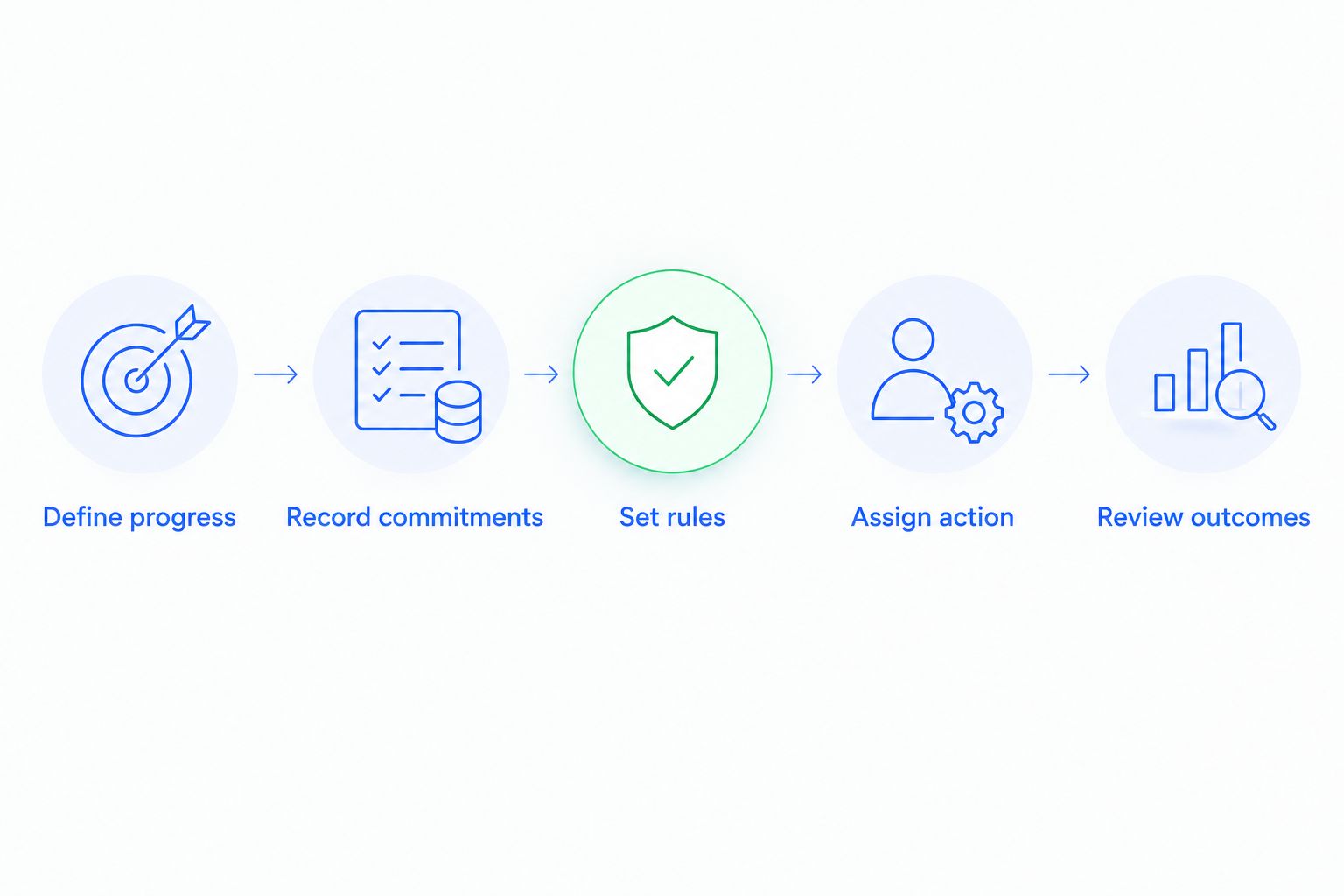
1. Define progress
Write down what must happen before an opportunity moves to its next stage. Use observable events such as a completed discovery conversation, a requested proposal, or an agreed review meeting.
Keep seller activity separate from buyer commitment. A sent email proves outreach happened; it does not prove the buyer accepted the proposed next step.
2. Record commitments
Use 4 fields to make the next action clear: owner, action, due date, and buyer commitment. Treat this as a review template, not a claim about a particular CRM's field configuration.
For example, distinguish an internal task to send a document from a customer agreement to discuss that document. Both belong in the record, but they answer different questions about progress.
3. Set rules
Define conditions that deserve review, such as an overdue task or an opportunity without a recorded next action. Set timing around your own sales process rather than copying an arbitrary inactivity threshold.
Avoid assigning the same meaning to silence at every stage. A buyer reviewing a proposal and a new inquiry awaiting a first response need different follow-up logic.
4. Assign action
Give each flagged opportunity a responsible person and a specific task. The task should address the concern: confirm a review date, clarify an objection, or establish whether the project is still active.
Do not make the alert itself the finish line. Completing a task without resolving the underlying uncertainty leaves the deal just as unclear.
5. Review outcomes
Compare the original warning with what happened next. Was there a genuine blocker, an undocumented agreement, or a recordkeeping problem?
Adjust rules that repeatedly flag healthy opportunities. Keep the conditions that help your team discover missed commitments or clarify buyer intent.
Why deal-risk signals vary
The same warning does not mean the same thing in every opportunity. Review the information behind the alert before changing a forecast or removing a deal from your active pipeline.
- Recorded conversations: Email, WhatsApp, SMS, and calls contain different parts of the discussion. An incomplete record leaves the reviewer without the full context.
- Pipeline stage: Evaluate the next milestone against the opportunity's current stage, not a generic expectation for all deals.
- Task status: An overdue reminder identifies unfinished work. Check whether that work still matters and whether the customer is waiting for it.
- Workflow configuration: Automated actions follow configured conditions. Review those conditions when the alerts stop matching the way your team sells.
- Conversation summaries: A summary helps you review a discussion, but inspect the underlying message before acting on a sensitive or ambiguous commitment.
The practical lesson is simple: keep the evidence attached to the concern. Your salesperson should be able to explain why the opportunity was flagged without reconstructing the entire relationship from memory.
Can a CRM distinguish a quiet deal from a lost deal?
A CRM can organize evidence that helps you distinguish them, but silence alone does not establish that a deal is lost. Look for an agreed pause, a future review date, an unresolved question, or an explicit decision not to proceed.
Use 3 checks before treating silence as a negative signal: review the last buyer message, confirm the next agreed action, and inspect unfinished tasks. If those checks do not clarify the situation, ask the buyer directly.
Record the answer. A customer-requested pause should not remain indistinguishable from an opportunity nobody has followed up.
Can automated follow-up rescue an at-risk deal?
Automated follow-up can address a missed reminder or maintain a planned sequence, but it cannot establish buyer intent by itself. The message still needs to match the reason the deal stalled.
If the buyer asked for clarification, answer the question. If the buyer is waiting on an internal decision, confirm the appropriate next contact rather than repeating the original pitch.
Stop or revise a sequence when the conversation changes. Automation should support the agreed next step, not keep sending messages that no longer fit.
Where Archescrm fits
Archescrm is best for growing sales teams that need shared customer conversations, pipeline tracking, and automated follow-up. The sales CRM brings contacts, conversations, tasks, and sales activity into one place, helping your team see what needs attention next.
Archescrm supports email conversation summaries, workflow automation, and automatic opportunity movement based on customer interactions and configured workflows. Those capabilities support the records and actions behind a deal-risk review.
The boundary matters: workflow assistance is not proof of predictive accuracy. Evaluate the platform against the work you need to complete—finding context, assigning follow-up, and keeping opportunity records current—rather than assuming automation guarantees a sale.
What should you check before trusting a risk alert?
Use your 2026 evaluation to inspect the explanation, not just the notification. Ask the person demonstrating the workflow to connect the alert to its source and show the action your salesperson should take next.
Check these points against a real opportunity:
- Can you identify the message, task, or stage condition behind the concern?
- Can you tell the difference between customer activity and seller activity?
- Is there a responsible person for the next action?
- Does the workflow account for an agreed pause or changed conversation?
- Can your team review and correct the record when the alert is misleading?
A useful walkthrough should include an exception. Choose an opportunity that looks inactive but has a documented reason to wait, then inspect how your review process handles it. This exposes whether your rules recognize context or simply punish silence.
FAQ
Can a CRM tell me which deals are at risk without predictive scoring?
Yes—a CRM can support deal-risk reviews through recorded conversations, pipeline stages, tasks, and configured follow-up rules. Predictive scoring is a separate approach, not a requirement for identifying missed commitments.
What's the best first warning sign to track?
Start with missing or overdue next actions because they point to work your team can investigate directly. Confirm the customer context before treating the warning as evidence that the deal will fail.
Does a buyer opening an email mean the deal is safe?
No—an email open does not confirm buying intent or agreement to proceed. Look for a substantive reply, an agreed next step, or a completed buyer milestone.
Can Archescrm help my team review stalled deals?
Archescrm supports the underlying review work through pipeline tracking, shared customer communications, conversation summaries, and automated follow-up tasks. Assess those capabilities against your team's review process rather than assuming a guaranteed prediction of deal outcomes.
Should I automatically close a deal when the buyer stops replying?
Do not use silence alone to close an opportunity as lost. Review the latest conversation and agreed next action, then confirm whether the buyer has paused or ended the process.
Is a risk score the same as a probability of closing?
Do not assume a risk score is a closing probability. Check the system's definition, the inputs behind the score, and how its interpretation relates to your sales process.
How do I stop deal alerts from creating more admin work?
Tie each alert to a specific decision or assigned action. Review repeated alerts and remove conditions that produce noise without helping your team resolve a real gap.
One last thing
A reply is not always progress. A buyer can answer quickly while leaving the budget, decision, or next commitment unresolved. Read what changed in the conversation before treating the activity as a healthy signal.
For your next 2026 pipeline review, choose 1 opportunity with plenty of activity and ask: what has the buyer actually agreed to do next? If the record cannot answer that question, clarify the commitment before sending another follow-up. Better evidence beats a busier activity log.