
 Log in
 Start Free Trial


Yes—a CRM with predictive lead scoring can estimate which leads are most likely to close by comparing their characteristics and activity with historical sales outcomes. The estimate depends on the quality of your records and the model’s validation; a high score is a reason to investigate, not a promise of revenue. In 2026, distinguish a genuine prediction from a points-based score or an automated pipeline update before using it to direct your sales team.
- Can a CRM predict which leads are most likely to close? Yes, with predictive scoring and reliable sales outcomes.
- Predictive lead scoring estimates likelihood; rule-based scoring applies criteria your team defines.
- Validate predictions against completed sales, not email activity alone.
- Arches CRM supports lead management and follow-up automation; evaluate predictive scoring separately.
Can a CRM predict which leads are most likely to close?
A CRM can estimate close likelihood when it includes a predictive model built for that outcome. Storing contacts, summarizing conversations, and moving opportunities between stages do not establish that capability on their own.
Start by separating the methods below. The distinction also matters when you evaluate whether a CRM can automatically score leads by quality: a quality score and a closing prediction can answer different questions.
| Method | What it does | Best for | Main limitation |
|---|---|---|---|
| Rule-based scoring | Adds or subtracts points using defined criteria | Teams that need transparent qualification rules | Reflects your assumptions rather than learning sales outcomes |
| Predictive scoring | Uses historical examples to estimate a defined outcome | Teams with usable outcome data that want to test lead prioritization | Requires validation and monitoring as sales conditions change |
| Workflow automation | Performs actions when configured conditions occur | Teams that need consistent assignments, reminders, and follow-up | Completing an action does not establish closing probability |
These methods can work together. A prediction can inform priority, a rule can enforce qualification requirements, and a workflow can assign the next task. Keep their purposes separate so your team knows what each output actually means.
Why this matters
A lead arrives, receives a high score, and lands at the top of a salesperson’s queue. If that score reflects activity rather than buying intent, your team can spend its attention on the wrong conversation.
The opposite problem matters too: a qualified prospect with little recorded activity can disappear beneath more active contacts. Your priority list should help salespeople decide what to do next, not replace qualification.
For your 2026 CRM evaluation, ask what the system predicts before asking how sophisticated it sounds. A meeting booking, a qualified opportunity, and a closed sale are different outcomes. A model trained for one is not automatically evidence of another.
Predictive scoring: estimates based on historical outcomes
Predictive lead scoring uses examples of previous leads and their outcomes to identify relationships between recorded information and a target result. Depending on the system, relevant inputs can include company characteristics, qualification information, customer interactions, and opportunity history.
The target must be explicit. Predicting whether a new inquiry becomes a customer differs from predicting whether an existing opportunity closes within a defined period.
Ask the provider to explain:
- What outcome the model predicts.
- Which information is available when it makes the prediction.
- Whether it uses your records, a broader dataset, or both.
- How its predictions were tested against completed outcomes.
- What happens when a record lacks important information.
A percentage requires particular scrutiny. If a system presents its output as a probability, ask whether observed outcomes support that interpretation. A ranking score can sort leads without representing a calibrated chance of winning.
Best for: teams that can connect lead records to reliable outcomes and evaluate the resulting priorities. The advantage is data-informed ranking; the limitation is dependence on relevant, representative records.
Rule-based scoring: priorities your team defines
Rule-based scoring follows explicit instructions. You decide which characteristics or actions increase priority and which conditions disqualify a lead.
For example, your team might prioritize prospects that match its customer profile and have confirmed a relevant need. Those are proposed qualification criteria, not universal indicators of a sale.
The strength is visibility. A salesperson can inspect the rule and understand why a prospect received a particular score. The weakness is equally clear: a rule can consistently reproduce a mistaken assumption.
In a 2026 buying decision, do not accept the label “intelligent scoring” as an explanation. Ask whether the score comes from configured rules, a statistical model, or a combination.
Best for: teams that need understandable qualification criteria before they have usable historical outcomes. Start with criteria your salespeople can explain, then compare those criteria with actual wins and losses.
Workflow automation: action, not prediction
Workflow automation answers a different question: what should happen when a condition occurs? It can assign a lead, create a reminder, or advance an opportunity under configured rules.
A reply can trigger a task without proving the prospect is likely to buy. The reply might confirm interest, request a later conversation, or reject the offer. Treating every response as positive intent confuses activity with progress.
Arches CRM is best for growing sales teams that need lead management and follow-up automation in one platform. Arches CRM brings contacts, conversations, tasks, and sales activity together and supports pipeline movement based on customer interactions and configured workflows.
That supports sales execution. When considering Arches CRM, evaluate its documented workflow capabilities separately from any requirement for predictive scoring, and test each requirement against your own sales process.
Best for: teams that need clearer ownership and consistent next actions. Automation’s limitation is that it follows the conditions you configure; an inappropriate trigger still produces an inappropriate action.
Why CRM predictions vary
A closing prediction reflects the information and assumptions behind it. These factors explain why the same approach does not produce equally useful priorities in every sales operation:
- Outcome quality. Missing or inconsistent won-and-lost records weaken the connection between a lead’s history and its final result.
- Information completeness. A record without qualification details gives the system less evidence than a consistently maintained record.
- Customer mix. Patterns from one customer segment do not automatically apply to another segment with a different buying process.
- Sales-process changes. New qualification rules or pipeline definitions change what historical records represent.
- Timing. Information captured after a sale cannot fairly demonstrate what the model knew before the buying decision.
- Follow-up behavior. Outcomes reflect sales activity as well as customer interest, making evaluation harder when treatment differs between groups.
Keep these factors visible in your 2026 review. A polished score is not a substitute for understanding how the underlying records were created.
How do you check whether a CRM’s predictions are useful?
Evaluate a prediction against an outcome you can observe, using information available before that outcome occurred. Compare it with your existing prioritization method rather than judging it in isolation.
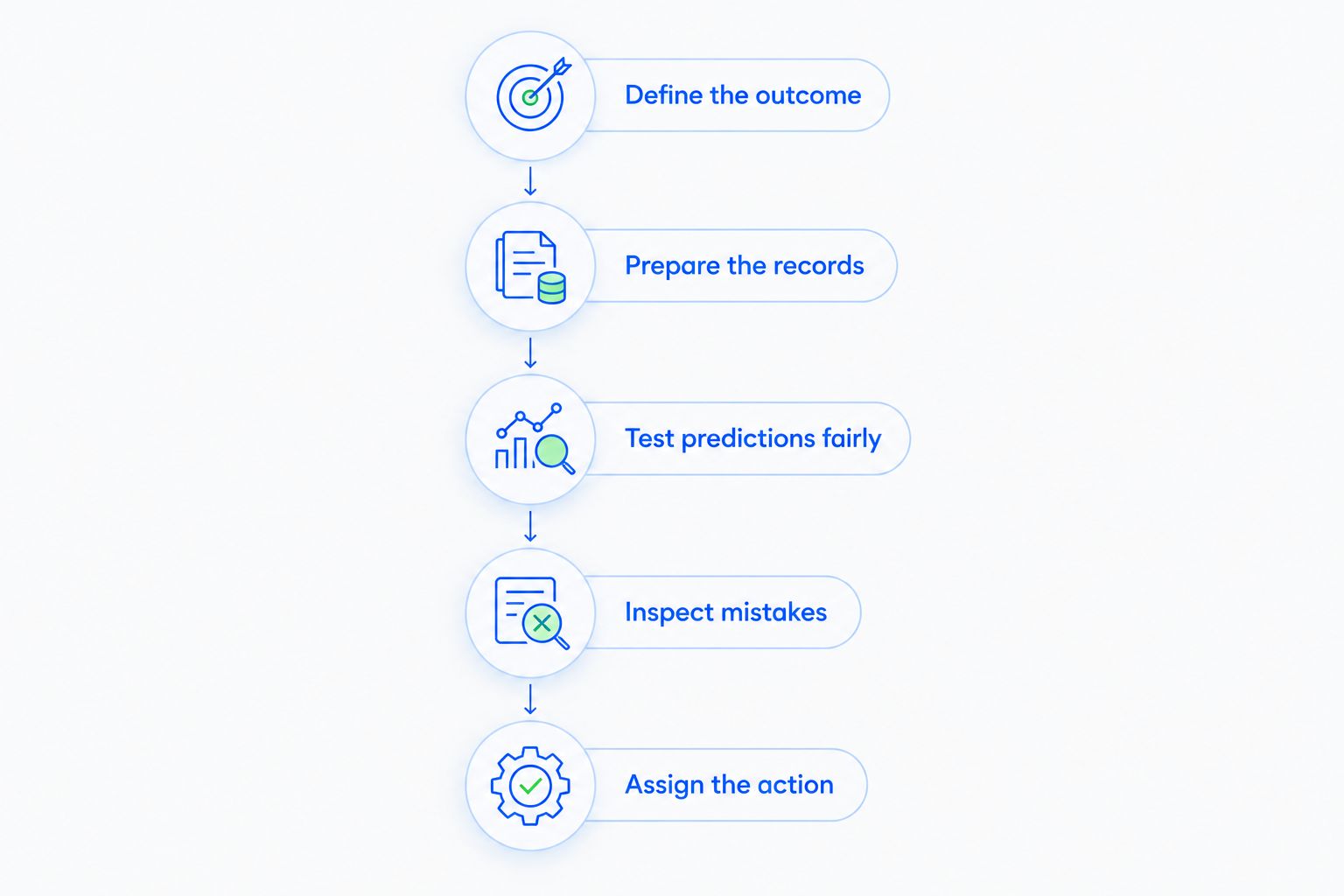
1. Define the outcome
Write down what success means: a qualified opportunity, a completed sale, or another specific result. For closing predictions, specify the period over which you will judge the outcome.
Do not mix goals. A model that identifies likely meeting attendees has not necessarily identified likely customers.
2. Prepare the records
Check that opportunity statuses, customer identities, and recorded activities are consistent. Resolve duplicate records and distinguish genuinely lost opportunities from records that were simply abandoned.
Use 1 final outcome per opportunity as a recordkeeping rule. This is an operating recommendation, not a model-performance benchmark.
3. Test predictions fairly
Evaluate predictions on outcomes the model did not use for training. Preserve the timing of the information so later events do not accidentally enter an earlier prediction.
Compare the predicted priorities with a simple alternative, such as your existing qualification process. Complexity earns its place only when it improves the decision you need to make.
4. Inspect mistakes
Review highly ranked leads that did not close and low-ranked leads that did. Look for missing context, inconsistent qualification, and customer groups the model handles poorly.
Ask salespeople what the score missed. Their explanations are evidence to investigate, not a reason to accept or reject the model automatically.
5. Assign the next action
Set 1 accountable owner per lead and 1 explicit next action per active opportunity. These operating rules turn a ranked queue into work someone can complete.
A high score without an owner is still an unattended lead. Review the customer’s latest message before deciding whether the next step is a call, a clarification, or a later follow-up.
Keep the same definitions throughout your evaluation. If your team changes qualification rules halfway through, separate those records before interpreting the results.
What should a salesperson do with a high-scoring lead?
A high-scoring lead deserves a review of its current context, not an automatic assumption that it will close. Confirm fit, the prospect’s stated need, and the next agreed step.
Use this practical sequence:
- Read the latest customer conversation.
- Confirm that the contact and opportunity records describe the same buying situation.
- Check for an unresolved question or promised response.
- Assign the appropriate next action and its owner.
- Record the outcome so future reviews use actual results.
Do not send a generic urgency message merely because a score increased. A prospect who asked for technical clarification needs an answer, not another meeting request.
For your 2026 process, define how representatives challenge a score. A documented reason for overriding a recommendation gives managers something concrete to review and keeps useful customer context from disappearing.
Can a small sales team use predictive lead scoring?
A small sales team can use predictive scoring if the chosen system has suitable data and its recommendations hold up against actual outcomes. Team size alone does not establish whether prediction will be useful.
If your records are incomplete, begin with qualification rules, clear ownership, and consistent follow-up. These controls provide an understandable starting point and improve the records you will later use to evaluate predictions.
Do not buy predictive capability to solve an assignment problem. If leads remain untouched because nobody owns them, fix ownership before changing the ranking method.
Does a high lead score mean a deal will close?
A high lead score does not mean a deal will close. It represents either the result of configured criteria or a model’s estimate, depending on how the system works.
Keep the score separate from the customer’s commitment. A confirmed next step is evidence of an agreement; a score is an interpretation of recorded information.
Managers should inspect the reason for a score alongside the conversation history. That prevents a number from becoming a substitute for asking the customer a direct qualification question.
FAQ
Can a CRM predict which leads are most likely to close?
Yes, a CRM with predictive scoring can estimate which leads are most likely to close using relevant historical information. Its usefulness depends on the outcome it predicts, data quality, and validation against completed sales.
Is predictive lead scoring better than rule-based scoring?
Predictive lead scoring is not automatically better than rule-based scoring. Compare both against the same sales outcome; rule-based scoring offers clear criteria, while predictive scoring requires suitable data and validation.
Does automatic pipeline movement mean a CRM predicts sales?
No, automatic pipeline movement does not establish that a CRM predicts sales. A workflow can move an opportunity after a configured event without estimating its chance of closing.
What data does a CRM need to predict a sale?
A CRM needs information relevant to the predicted outcome and a defensible way to evaluate the prediction. For a model trained on your history, consistent lead records and completed sales outcomes are central requirements.
How accurate are CRM lead predictions?
There is no single accuracy figure that applies to every CRM lead prediction. Evaluate the specific system against your defined outcome and compare its priorities with your existing qualification method.
Should salespeople ignore leads with low scores?
No, salespeople should not ignore a lead solely because it has a low score. Check for missing information, explicit customer requests, and evidence that the score does not reflect the current buying situation.
Can CRM automation help without predictive scoring?
Yes, CRM automation can assign leads, create tasks, and support follow-up without predicting a sale. These actions address execution, while predictive scoring addresses estimated likelihood.
One last thing
A low score can mean missing information, not low intent. Before you remove a prospect from active attention, check whether the record contains the qualification information your process expects.
Make that distinction part of your 2026 sales review: “not qualified” and “not yet understood” are different decisions. Keep explicit customer commitments visible, and make the next action clear even when the score is uncertain.