
 Log in
 Start Free Trial


Yes, a CRM can automatically score leads by quality when it includes scoring rules or a predictive scoring model that evaluates customer fit and buying signals. The score prioritizes your sales team's attention; it does not prove purchase intent, and its usefulness depends on the information and rules behind it.
- Can a CRM automatically score leads by quality? Yes—when scoring capabilities evaluate customer fit and buying signals.
- Separate lead quality from engagement: repeated activity does not establish a genuine sales opportunity.
- Arches CRM suits growing sales teams needing CRM workflow automation; assess lead-scoring capabilities separately.
- Connect each priority level to an owner and a follow-up action, not just a dashboard.
Can a CRM automatically score leads by quality?
Yes—but automatic lead scoring is a specific capability, not something every CRM automatically includes. A scoring system evaluates recorded information, applies its rules or model, and updates a lead's priority as that information changes.
The main approaches differ in how they determine quality. For your 2026 CRM evaluation, compare the scoring method with the evidence your team actually records.
| Scoring approach | Best for | How it works | Main advantage | Main limitation |
|---|---|---|---|---|
| Rule-based scoring | Teams with clear qualification criteria | Adds or subtracts priority based on defined attributes and actions | Reps can inspect the logic | Poor rules produce poor rankings |
| Predictive scoring | Teams with usable historical sales outcomes | Uses patterns in past outcomes to estimate lead potential | Finds relationships beyond a short rule list | Historical gaps and bias affect the model |
| Combined scoring | Teams needing model guidance and explicit business rules | Combines predictive signals with qualification requirements | Keeps business constraints visible | Requires ownership of both rules and model behavior |
Scoring becomes useful when it changes which lead to contact next. A ranking without an assigned next action leaves the same follow-up problem in place.
Why this matters
A lead arrives, someone reads the message, and nobody owns the next step. Automatic scoring addresses prioritization, but ownership and follow-up still need a workflow.
A high score is a reason to inspect the opportunity, not permission to skip qualification. Your team needs to know why the lead ranks highly, what the customer actually said, and which action belongs to the assigned rep.
For a 2026 sales process, make the score explainable enough that a rep can challenge it. Otherwise, the CRM replaces an unstructured list with an unexplained ranking.
Rule-based scoring: best for clear qualification criteria
Rule-based scoring starts with your definition of a suitable customer. You specify which attributes and behaviors raise priority, which lower it, and which disqualify the inquiry entirely.
Useful criteria include a relevant business need, a supported customer type, and a direct request to discuss a purchase. Treat these as possible inputs, not universal rules: a criterion belongs in your model only when it matters to your sales process.
The advantage is transparency. A rep can see the condition that changed a lead's priority and correct an inaccurate field.
The limitation is maintenance. If your target customer changes but the rules do not, the CRM keeps applying yesterday's definition of quality. Choose rule-based scoring when your team can explain and maintain its qualification criteria.
Predictive scoring: best for usable historical outcomes
Predictive scoring uses historical records to identify patterns associated with outcomes such as qualification or a closed deal. Its usefulness depends on the outcome being predicted and the quality of the underlying records.
Ask what the prediction means. A model predicting a meeting booking answers a different question from a model predicting a completed sale, even when both display a lead score.
The advantage is finding relationships that a short checklist misses. The limitation is that a model learns from recorded history, including inconsistent qualification, incomplete records, and past targeting decisions.
For a 2026 evaluation, ask how the provider handles missing information, explains influential signals, and checks performance after deployment. Choose predictive scoring when you can evaluate the prediction against actual outcomes—not simply because the feature uses AI.
Combined scoring: best for keeping business rules explicit
Combined scoring uses a model alongside requirements your business controls. For example, predictive interest should not override a confirmed requirement that your business cannot meet.
This approach separates a promising pattern from permission to pursue an opportunity. It gives your team a way to preserve qualification boundaries while using model-generated guidance.
Its weakness is complexity. When rules and predictions disagree, someone needs to decide which takes precedence and explain that decision to reps. Choose combined scoring only when your team can maintain that decision process.
What should a CRM use to judge lead quality?
Start with 2 dimensions: fit and intent. Fit asks whether you can serve the prospect; intent asks whether the prospect is taking meaningful steps toward buying.
Keep those dimensions separate long enough to understand them. A suitable prospect with no current project needs different follow-up from an active buyer whose requirements you cannot meet.
Customer fit
Fit includes the needs, customer characteristics, and requirements relevant to your offer. Use fields your team can verify rather than treating an empty field as a negative answer.
A missing requirement is unknown, not automatically unsuitable. Route uncertain records for qualification instead of pretending the score resolves the uncertainty.
Buying intent
Intent concerns the substance of the customer's actions. A message asking to discuss implementation deserves different treatment from a general request for information.
Read the conversation. Repeated messages about an unresolved support issue are activity, but they are not evidence of a new purchase.
Recency and qualification
Older activity should not automatically carry the same significance as a current buying conversation. Decide how your process handles stale signals and new information that contradicts an earlier assessment.
Qualification also needs a path for exceptions. A rep who learns that the project has stopped should be able to record that fact and prevent outdated activity from dominating the priority.
How do you set up automatic lead scoring?
Use a short sequence that connects evidence to action. Before building automation in 2026, answer 3 questions: what makes a lead qualified, what evidence supports that judgment, and what happens next?
1. Define quality
Write a practical qualification statement. Describe the customer you can help, the problem you solve, and the evidence that justifies a sales conversation.
Avoid circular definitions such as a good lead is a lead with a high score. Your definition must work before any scoring system exists.
2. Map signals
Identify the contact fields, conversation details, and sales outcomes your CRM actually captures. Separate directly observed facts from assumptions.
Decide how to handle missing data. A system that silently interprets unknown information as poor fit creates a ranking that looks more certain than it is.
3. Set rules
Choose the scoring approach and define the meaning of each priority level. Include disqualification conditions and a review path for ambiguous records.
Do not copy another company's thresholds. A threshold is useful only when it separates leads that your team should handle differently.
4. Assign action
Give each actionable lead 1 accountable owner. Specify the next task, the relevant conversation context, and the condition that ends or changes the follow-up.
A score update should not create conflicting instructions. Check what happens when an existing opportunity, a new inquiry, and an automated follow-up all refer to the same customer.
5. Review outcomes
Compare prioritization with qualification and sales outcomes. Examine high-ranked leads that went nowhere and low-ranked leads that became genuine opportunities.
Adjust the cause of the error, not just the displayed threshold. Sometimes the problem is an incorrect field, a missing interaction, or a qualification rule that no longer fits your business.
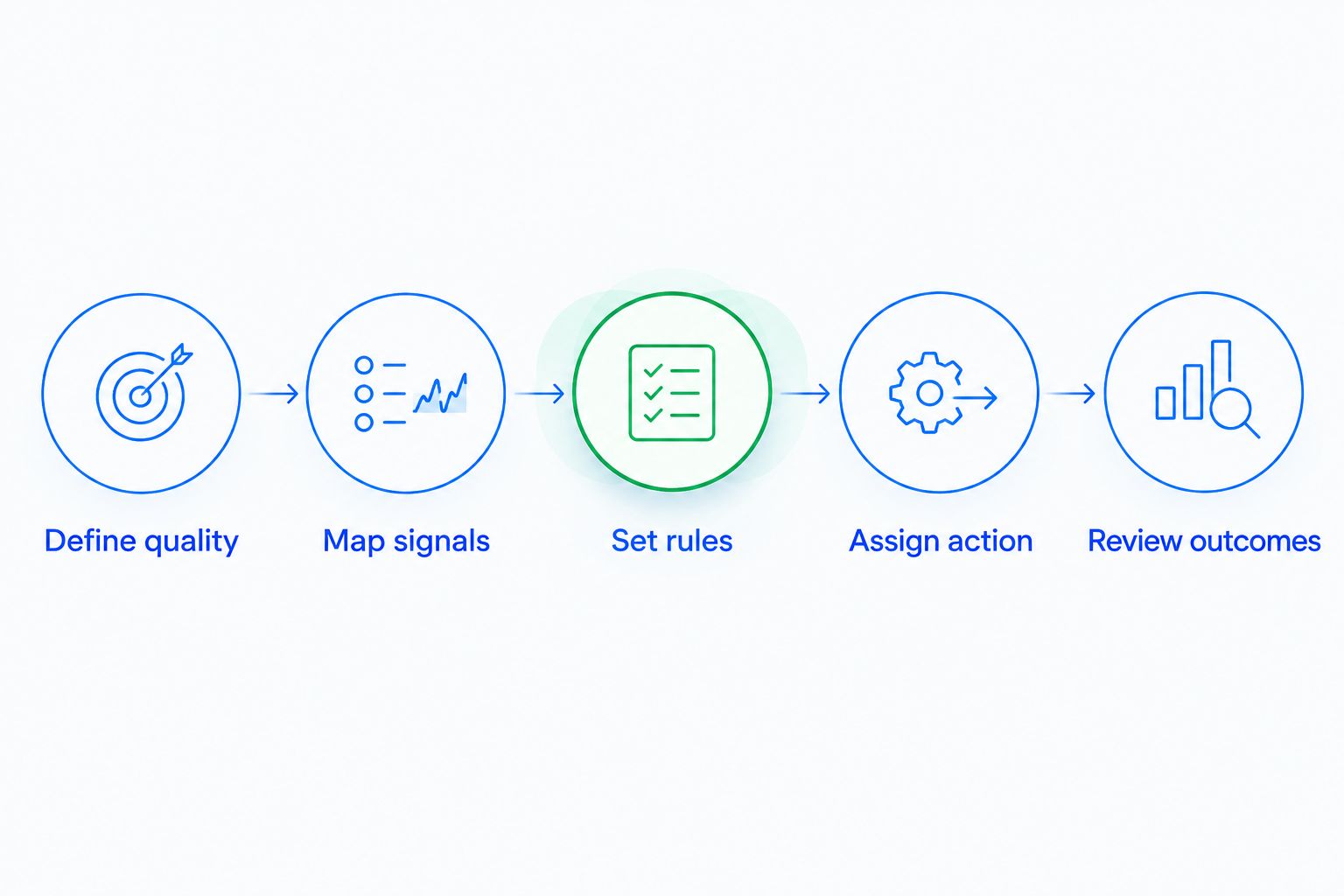
The sequence matters because scoring is not an isolated dashboard feature. It sits between the information you collect and the work your sales team performs.
Why automatic lead scores vary
Automatic lead scores reflect the system's inputs and decisions. In 2026, compare scoring systems by what they measure rather than assuming their displayed values mean the same thing.
- Qualification definition: A meeting-ready lead and a purchase-ready opportunity represent different outcomes.
- Available information: Missing requirements or disconnected conversations leave important evidence outside the assessment.
- Signal interpretation: A reply can express buying interest, rejection, or an unrelated question; activity alone does not distinguish them.
- Historical outcomes: Predictive models depend on the outcomes and customer records used to develop them.
- Timing rules: The treatment of old activity changes whether a previously engaged lead remains a priority.
- Record quality: Duplicate or inconsistent records fragment the information used to judge an opportunity.
Do not compare scores across CRMs as though they share a standard scale. Compare the resulting decisions: which leads get attention, why they qualify, and whether the next action makes sense.
What should you ask during a CRM demonstration?
Ask the provider to show a complete scoring decision using a realistic example from your sales process. Watch the explanation, not just the final value.
Use these checks during your 2026 CRM evaluation:
- Can the rep see which facts influenced priority?
- What happens when a required field is unknown?
- Does a negative reply reduce priority or stop outreach?
- Can a rep correct a mistaken qualification?
- What changes when the same person submits another inquiry?
- Does the priority create an owned task, or only change a dashboard?
Then change the example. Replace a buying question with a rejection, or remove a key qualification detail, and ask the provider to explain the result.
This exposes the distinction between a convincing demonstration and a system your reps can trust. Buy the decision process, not the appearance of precision.
Where does Arches CRM fit into lead prioritization?
Arches CRM is best for growing sales teams that need lead management and follow-up workflows in one CRM. Its stated capabilities include capturing and assigning leads, tracking opportunities, automating tasks and follow-up sequences, and bringing customer communications together.
Arches CRM also summarizes email conversations and moves opportunities through sales pipelines based on customer interactions and configured workflows. Those capabilities support the work around prioritization: understanding the conversation, assigning responsibility, and keeping the next step visible.
Evaluate automatic quality scoring as a separate requirement. Conversation summaries and automated pipeline movement are not, by themselves, evidence of a numeric or predictive lead-scoring feature.
The practical strength is coordinating sales activity. The limitation for a scoring-led purchase decision is that workflow automation alone does not establish how lead quality is calculated.
Can a lead score replace sales qualification?
No. A lead score sorts attention using available evidence; qualification confirms whether the customer has a problem you can solve and a realistic next step.
Use the score to decide where to investigate first. Keep the customer's stated requirements and the rep's verified findings visible alongside it.
Does a high engagement score mean a lead is ready to buy?
No. High engagement shows activity, while purchase readiness requires context about the customer's need and intentions.
A prospect researching a topic and a buyer discussing a project can both generate activity. Your scoring logic should distinguish the substance of those interactions instead of rewarding volume alone.
Should every high-scoring lead receive an automated message?
No. Check the current conversation, outreach permissions, and existing ownership before triggering another message.
An active sales conversation needs a different next step from an unanswered inquiry. Automate the appropriate action, not the same message for every lead.
FAQ
Can a CRM automatically score leads by quality without AI?
Yes. Rule-based scoring evaluates lead attributes and behaviors against criteria your team defines. AI is not required to automate that calculation.
What's the difference between lead scoring and lead qualification?
Lead scoring ranks attention, while qualification confirms whether an opportunity meets your sales criteria. Use scoring to guide investigation, not replace it.
Is predictive lead scoring better than rule-based scoring?
Neither approach is automatically better. Rule-based scoring offers explicit logic; predictive scoring depends on historical data, a defined outcome, and ongoing evaluation.
Can a CRM score leads when contact information is missing?
A scoring system can evaluate available information, but missing details limit the assessment. Keep unknown information distinct from a confirmed qualification failure.
What should happen when a lead's score increases?
A meaningful priority change should trigger an appropriate next action with a clear owner. Check existing conversations before creating another outreach task.
Does Arches CRM's pipeline automation mean it includes predictive scoring?
No. Moving opportunities based on interactions and configured workflows is different from predicting lead quality. Evaluate the scoring requirement separately from pipeline automation.
How do I know whether automatic lead scoring works?
Compare the system's priorities with verified qualification and sales outcomes. Investigate both high-ranked leads that fail to qualify and low-ranked leads that become real opportunities.
One last thing
Inspect the leads your scoring system deprioritizes, not just the ones it promotes. Successful low-ranked leads reveal qualification evidence your current rules or model missed.
Before expanding automation, ask a rep to explain why a priority lead deserves attention and what should happen next. If the explanation stops at the score, the process is not ready.