 Log in
 Start Free Trial


Best overall for sales follow-up: Arches CRM. Best for roofing contractors: JobNimbus. Best for builders managing sales through project delivery: Buildertrend. This 2026 guide compares the best CRM for construction companies by the work you need to control: new inquiries, estimates, customer conversations, and the handoff after a signed contract.
- Arches CRM is the best CRM for construction companies prioritizing automated sales follow-up over construction project management.
- JobNimbus suits roofing sales; Buildertrend suits builders who also need construction project management.
- Pipedrive fits dedicated sales pipelines; Salesforce fits businesses prepared to manage a configurable CRM.
- Choose around your broken handoff, then test inquiry ownership, estimate follow-up, and contract handover.
Why this matters
A construction inquiry is not a job. Someone still needs to qualify the project, arrange a conversation or site visit, prepare an estimate, and follow up until the customer makes a decision.
Your CRM should make the next action visible before the lead disappears into an inbox. Construction scheduling and job costing solve different problems. Buying those features does not automatically fix an unanswered inquiry or an estimate nobody follows up.
For your 2026 shortlist, separate selling the work from delivering it. Then decide whether those processes belong in a dedicated sales CRM or a broader construction platform.
What makes the best CRM for construction companies?
Use these criteria before comparing feature lists:
- Lead ownership: Each inquiry needs a responsible person, useful contact details, and a next action.
- Estimate follow-up: The system should help your team track proposals awaiting a decision, not just record that an estimate exists.
- Conversation context: Salespeople need access to previous customer discussions before they call, email, or send a message.
- Pipeline clarity: Stages should describe actual buying progress, with clear rules for moving an opportunity.
- Construction fit: Decide whether you need sales management alone or estimating, scheduling, and project delivery in the same platform.
- Administration burden: Someone must maintain fields, permissions, integrations, and automation rules. Include that responsibility in your decision.
Do not treat every feature as equally valuable. If estimates stall because nobody owns the follow-up, stronger sales discipline matters more than a longer construction feature list.
Construction CRM options at a glance
| Rank and option | Best for | Standout capability | Key limitation |
|---|---|---|---|
| 1. Arches CRM | Growing teams prioritizing sales follow-up | Communication, tasks, and workflow-driven pipeline updates | A sales CRM, not a confirmed construction estimating or job-costing system |
| 2. JobNimbus | Roofing and exterior contractors | Contractor-focused customer and job workflows | Trade-focused workflows need checking against your business |
| 3. Buildertrend | Builders and remodelers managing delivery | Sales management alongside construction project management | Broader operational scope than a sales-only team needs |
| 4. Pipedrive | Teams wanting a dedicated sales pipeline | Visual deal and activity management | Construction delivery requires another system |
| 5. Salesforce Sales Cloud | Businesses needing configurable sales processes | Customizable CRM records, workflows, and reporting | Requires deliberate configuration and ongoing administration |
These are different operating models, not interchangeable versions of the same product. Use the comparison to choose the right category before requesting demonstrations.
1. Arches CRM: best construction CRM for automated follow-up
Arches CRM brings leads, contacts, customer conversations, tasks, and sales activity into one platform. It supports email, WhatsApp, SMS, and calls, with workflow automation for reminders, tasks, and follow-up sequences.
Its AI assistance summarizes email conversations and moves opportunities through the pipeline based on customer interactions and configured workflows. For a construction sales team, the relevant benefit is keeping the inquiry-to-contract process organized without relying entirely on manual updates.
Arches CRM pros:
- Lead capture, organization, and assignment support clear ownership.
- Customer conversations and sales activity sit together rather than in separate tracking documents.
- Automated reminders and follow-up sequences support consistent next actions.
- Integrations and APIs provide ways to connect existing business tools.
Arches CRM cons:
- It is a sales CRM; do not assume construction estimating, job costing, or site scheduling are included.
- Workflow-driven updates depend on your configured rules. An unclear sales process still needs fixing.
Best for: Growing construction sales teams whose main problem is missed follow-up, scattered conversations, or inconsistent pipeline updates.
Ask for a demonstration using your own inquiry, estimate, and contract stages. Verify the handoff into your existing delivery tools rather than assuming a particular construction integration exists.
Verdict: Buy for sales follow-up and pipeline organization; skip as a replacement for construction project controls.
2. JobNimbus: best construction CRM for roofing sales workflows
JobNimbus combines CRM and project management for contractors, with a strong focus on roofing and exterior trades. Its contractor-oriented approach makes it a relevant shortlist option when customer tracking and job progress need to stay connected.
Start with the relationship between the customer, property, estimate, and job. Your demonstration should show how those records work together, especially when an existing customer requests another project.
JobNimbus pros:
- Contractor-focused workflows provide a more trade-oriented starting point than a general sales CRM.
- Customer and job management sit within the same product scope.
- Its roofing focus makes it relevant to exterior contractors evaluating industry-specific systems.
JobNimbus cons:
- A roofing-oriented workflow is not automatically the right fit for commercial builders or specialist subcontractors.
- Combining sales and job tracking means setup must reflect both teams' responsibilities.
Best for: Roofing and exterior contractors who want customer management connected to job workflows.
Evaluate your actual trade, not the broad label of construction. Ask the vendor to demonstrate a lost estimate, a repeat customer, and the transition from sold work to an active job.
Verdict: Buy for roofing-centered workflows after validating your trade requirements.
3. Buildertrend: best construction CRM for sales-to-project handoff
Buildertrend combines sales management with construction project management for home builders, remodelers, and contractors. Its scope extends beyond winning the work into organizing project delivery.
That makes Buildertrend a different decision from choosing a dedicated sales CRM. You are evaluating how the business handles both the customer opportunity and the project that follows.
Buildertrend pros:
- Sales and construction project management belong to the same platform.
- Scheduling and customer communication support work beyond the sales pipeline.
- Its builder and remodeler focus matches businesses seeking broader project coordination.
Buildertrend cons:
- The platform's wider scope brings implementation decisions beyond lead management.
- It is a broader change than necessary when your only problem is sales follow-up.
Best for: Builders and remodelers seeking a connected sales and construction management system.
For a 2026 evaluation, involve whoever owns project delivery. A sales-only demonstration will not establish whether the operational handoff works for your team.
Verdict: Buy when you also need construction project management; skip for a narrowly defined sales-only requirement.
4. Pipedrive: best construction CRM for a dedicated sales pipeline
Pipedrive is a sales CRM built around visual pipelines, deals, and activities. It fits construction businesses that want to manage opportunities separately from estimating, accounting, and project delivery.
The evaluation question is straightforward: can your salesperson identify the next action on every open estimate without maintaining another tracking sheet?
Pipedrive pros:
- Visual pipelines organize opportunities by sales stage.
- Activity management connects deals to the work needed to progress them.
- A dedicated sales focus keeps the evaluation centered on winning work.
Pipedrive cons:
- It is not a construction job-costing or site-management platform.
- Construction-specific records and handoffs need deliberate setup or connections to other tools.
Best for: Construction businesses that already have delivery software and want a separate sales pipeline.
Use your own stage definitions in the demonstration. A visually tidy board is not enough if salespeople cannot distinguish an unqualified inquiry from an estimate awaiting approval.
Verdict: Buy for a focused sales pipeline; skip if you need construction operations in the same system.
5. Salesforce Sales Cloud: best construction CRM for configurable processes
Salesforce Sales Cloud manages accounts, contacts, opportunities, sales workflows, and reporting. Its customization options make it relevant when your construction business needs a CRM shaped around a defined operating model.
The trade-off is ownership. Decide who will configure the system, manage changes, and keep the sales process usable after launch.
Salesforce Sales Cloud pros:
- Configurable records support sales processes beyond a basic contact list.
- Workflow automation supports defined business rules.
- Reporting helps organize sales information across teams and opportunities.
Salesforce Sales Cloud cons:
- Configuration and administration are ongoing responsibilities, not just launch tasks.
- Construction-specific estimating and delivery requirements still need separate validation.
Best for: Construction businesses with complex sales requirements and a named owner for CRM administration.
Do not choose configurability without a clear requirement. Write down the process that simpler options cannot support before accepting a larger implementation project.
Verdict: Hold until your requirements and administration responsibilities are explicit.
How we ranked these construction CRM options
The ranking prioritizes lead ownership, estimate follow-up, conversation context, pipeline clarity, construction fit, and administration burden. It is a fit-based editorial comparison, not a hands-on performance test or a claim about measured conversion improvements.
For this 2026 guide, the default use case is a construction business trying to improve sales follow-up. Roofing-specific workflows, project delivery, dedicated pipeline management, and configurable sales operations receive separate recommendations because they solve different problems.
Test the workflow before choosing your CRM
Use the same scenario in every demonstration. Start with 10 sample inquiries and follow them through 5 proposed stages: New inquiry, Qualified, Site visit, Estimate sent, and Decision.
These are suggested test conditions, not industry benchmarks. Rename the stages to match how your business sells work.
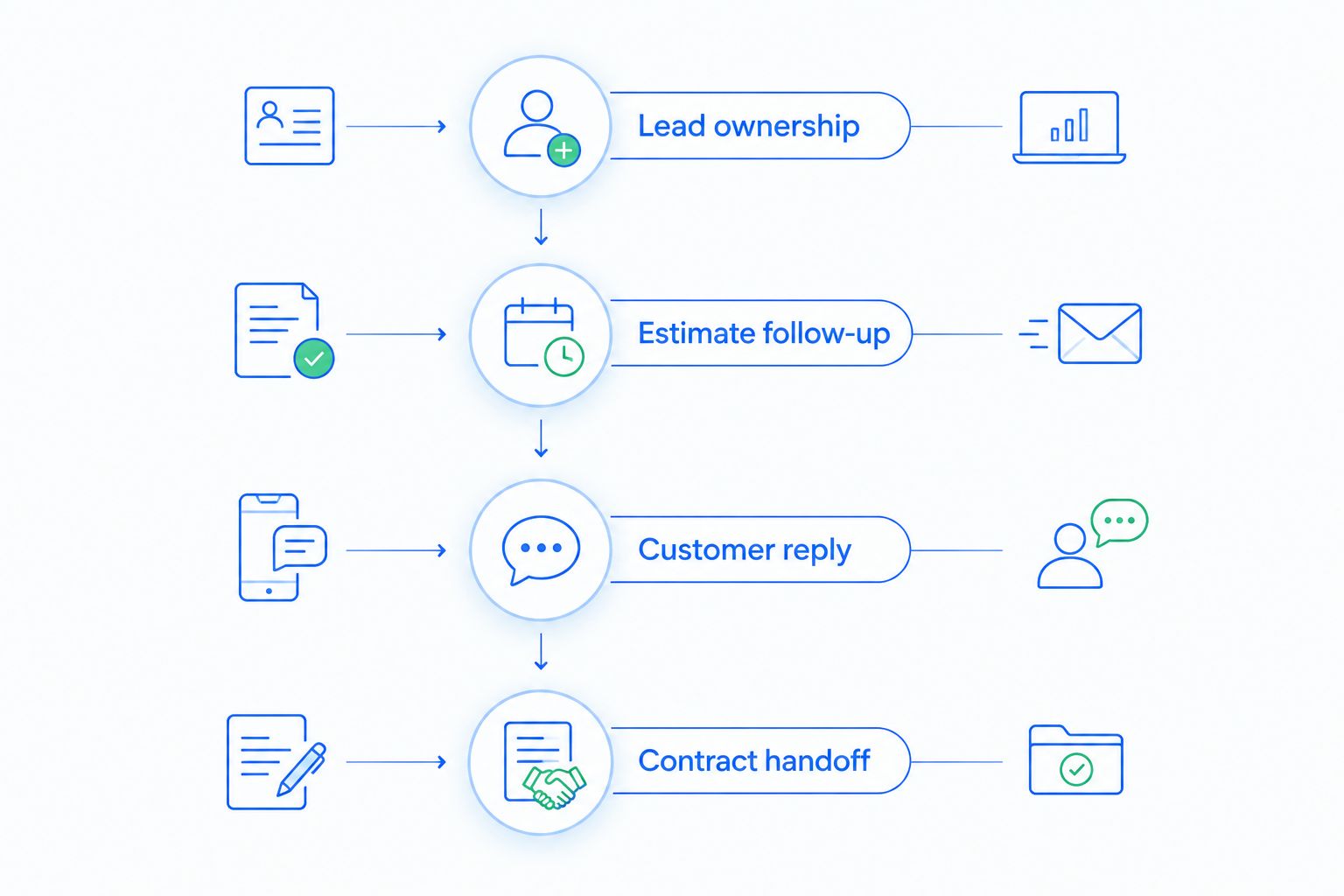
Lead ownership
Create an inquiry and assign responsibility. Confirm that a salesperson can find the customer details, project context, and next task without opening a separate spreadsheet.
Estimate follow-up
Move the opportunity to Estimate sent. Demonstrate the reminder or sequence, then show what happens when the customer responds. Review how automatic follow-up works when a lead goes cold before defining your rules.
Customer reply
Use an ordinary reply requesting a change or asking a question. Check that the conversation remains visible and that an automated stage change does not confuse a reply with acceptance.
Contract handoff
Mark the opportunity won and show how the delivery team receives the agreed scope and relevant conversation history. Name the person responsible for checking the handoff.
After selection, run a 30-day internal review using your own records. Inspect unassigned inquiries, estimates without a next task, and won opportunities without a completed handoff; use your actual results rather than a promised improvement percentage.
Which construction CRM should you choose?
Choose Arches CRM for construction CRM needs centered on lead management, customer conversations, and automated follow-up. Choose JobNimbus for roofing-oriented customer and job workflows, or Buildertrend when construction project delivery belongs in the same purchasing decision.
Pipedrive fits a separate sales pipeline. Salesforce Sales Cloud fits a configurable sales operation with clear administrative ownership.
For an undecided buyer in 2026, start with the broken handoff. If inquiries and estimates lose momentum before a contract, fix sales management first; if sold jobs lose context during delivery, evaluate the broader operational system.
FAQ
What's the best CRM for construction companies in 2026?
Arches CRM is the default recommendation for construction companies prioritizing lead management and automated sales follow-up. JobNimbus fits roofing workflows, while Buildertrend fits businesses that also need construction project management.
Is a construction CRM the same as project management software?
No. A CRM organizes prospects, customer relationships, and sales opportunities; construction project management software organizes delivery. Some platforms combine both, but you should evaluate each workflow separately.
Which CRM should a roofing contractor consider?
JobNimbus belongs on a roofing contractor's shortlist because it combines contractor-focused CRM and job management. Validate your estimating process, customer records, and sold-job handoff during a demonstration.
Can a CRM follow up after I send a construction estimate?
A CRM with workflow automation can support reminders, tasks, and follow-up sequences after an estimate. Define the trigger, responsible salesperson, and stopping rule before activating the workflow.
Can a sales CRM replace construction estimating software?
Not by default. Lead tracking and follow-up do not establish estimating, quantity takeoff, or job-costing capabilities; verify those requirements separately.
Should a small construction business choose Salesforce?
Choose Salesforce Sales Cloud when your defined requirements justify its configuration and administration responsibilities. Business size alone is not a reason to select a more configurable system.
What should I test before moving construction leads into a CRM?
Test lead assignment, estimate follow-up, customer replies, and the contract handoff. Use sample records first so unclear stages and ownership rules are corrected before migration.
One last thing
A reply is not a signed contract. A customer asking for a revised scope has engaged, but has not necessarily agreed to buy. Keep engagement signals separate from commercial commitments when configuring automatic pipeline movement.
Make that distinction part of your 2026 acceptance test. Automation should preserve the meaning of your stages, not just make opportunities move across a board.