 Log in
 Start Free Trial
Introduction
Every successful business depends on strong customer relationships. Whether you're attracting new leads, closing sales, providing customer support, or building long-term loyalty, understanding and managing customer interactions is essential for sustainable growth.
As businesses grow, managing customer information through spreadsheets, email inboxes, or handwritten notes quickly becomes inefficient. Teams struggle to find customer information, follow-ups get missed, communication becomes fragmented, and valuable sales opportunities can be lost.
This is where Customer Relationship Management (CRM) comes in.
A CRM is more than a contact database. It's a centralized platform that helps businesses manage customer relationships, organize sales opportunities, automate workflows, improve communication, and gain valuable insights into business performance.
Modern CRM platforms like Arches CRM combine customer management, sales pipeline tracking, communication tools, workflow automation, reporting, and artificial intelligence (AI) into one integrated solution that helps businesses work smarter and grow faster.
In this guide, you'll learn what CRM is, how it works, why it's important, its key features, the benefits it provides, and how businesses can use CRM software to improve customer relationships and increase revenue.
What Is CRM?
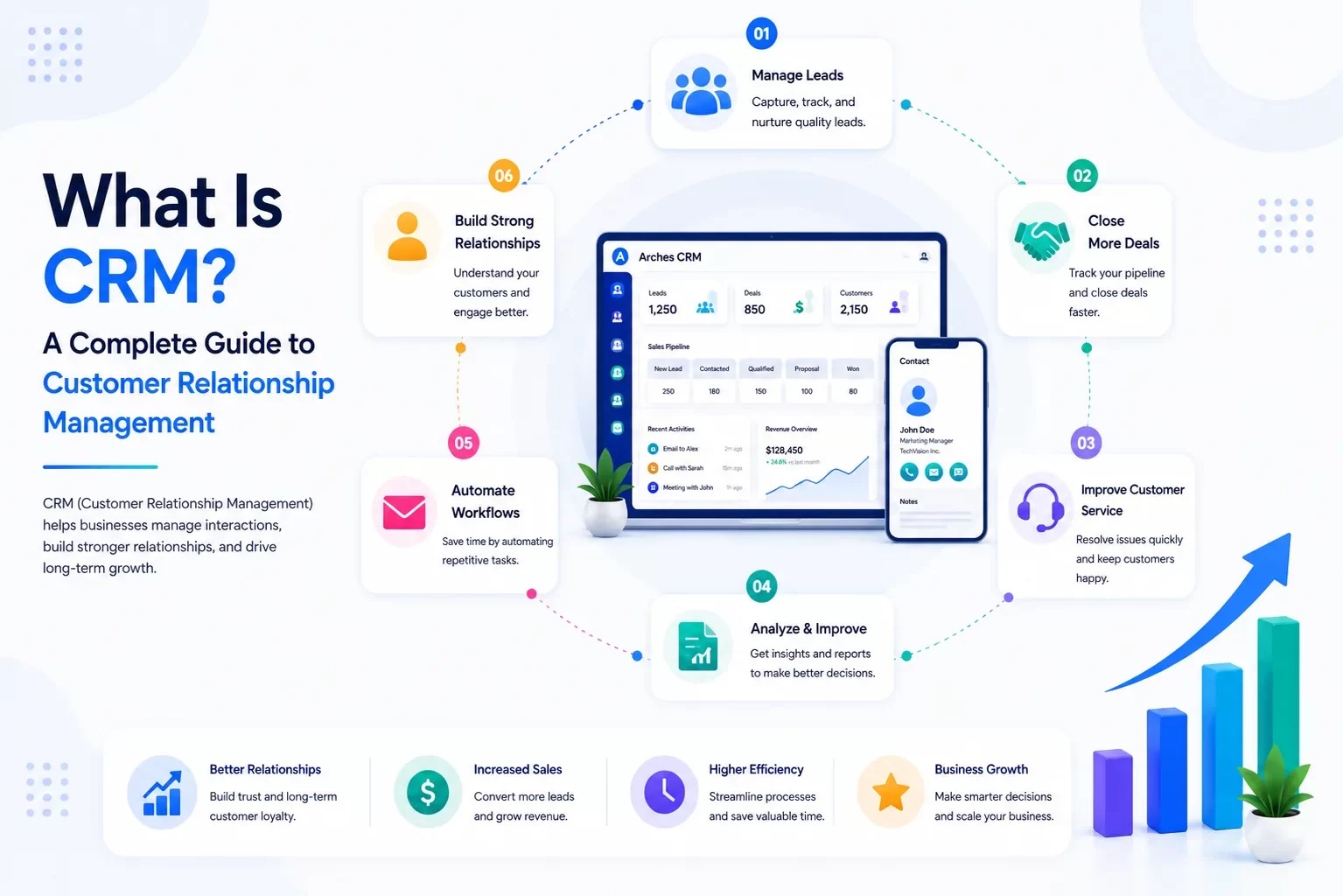
CRM stands for Customer Relationship Management. It refers to both the strategy and the software businesses use to manage interactions with prospects, customers, partners, and other stakeholders throughout the entire customer lifecycle.
A CRM system centralizes customer information into a single platform, making it easier for sales, marketing, customer service, and management teams to access accurate information and collaborate effectively.
Instead of storing customer details across spreadsheets, email threads, sticky notes, and multiple applications, everything is organized in one secure location.
A CRM helps businesses:
- Capture new leads
- Organize customer information
- Track sales opportunities
- Manage communications
- Schedule follow-ups
- Automate repetitive tasks
- Monitor sales performance
- Improve customer service
- Build stronger customer relationships
Why Is CRM Important?
Customer expectations have changed dramatically. People expect businesses to respond quickly, remember previous conversations, and provide personalized experiences across multiple communication channels.
Without a CRM, businesses often face common challenges such as:
- Lost or forgotten leads
- Slow response times
- Duplicate customer records
- Missed follow-ups
- Poor collaboration between departments
- Limited visibility into sales performance
- Manual administrative work
- Inaccurate sales forecasts
A CRM addresses these issues by providing a single source of truth for customer data and business activities. This enables teams to respond faster, work more efficiently, and make informed decisions based on real-time information.
How Does a CRM Work?
A CRM collects and organizes customer information from multiple sources into a centralized database.
Whenever a prospect submits a website form, sends an email, makes a phone call, or interacts through another connected channel, the CRM records that activity and associates it with the customer's profile.
As the relationship develops, the CRM continues to track:
- Contact information
- Sales opportunities
- Communication history
- Tasks
- Meetings
- Documents
- Quotes
- Invoices
- Support requests
- Notes
Every authorized team member has access to the same information, reducing duplication and improving collaboration.
Key Features of CRM Software
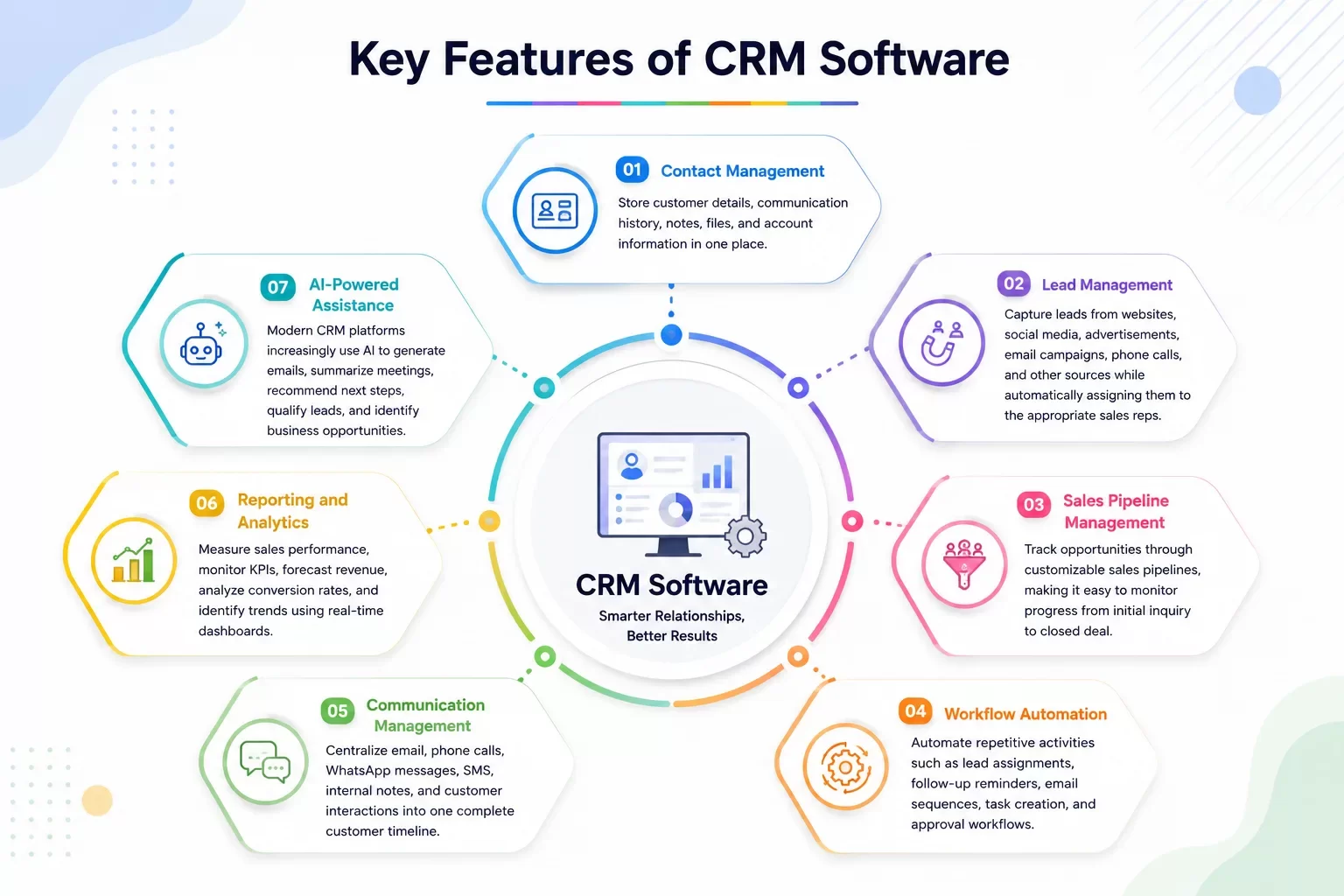
Contact Management
Store customer details, communication history, notes, files, and account information in one place.
Lead Management
Capture leads from websites, social media, advertisements, email campaigns, phone calls, and other sources while automatically assigning them to the appropriate sales representatives.
Sales Pipeline Management
Track opportunities through customizable sales pipelines, making it easy to monitor progress from initial inquiry to closed deal.
Workflow Automation
Automate repetitive activities such as lead assignments, follow-up reminders, email sequences, task creation, and approval workflows.
Communication Management
Centralize email, phone calls, WhatsApp messages, SMS, internal notes, and customer interactions into one complete customer timeline.
Reporting and Analytics
Measure sales performance, monitor KPIs, forecast revenue, analyze conversion rates, and identify trends using real-time dashboards.
AI-Powered Assistance
Modern CRM platforms increasingly use AI to generate emails, summarize customer meetings, recommend next steps, qualify leads, and identify business opportunities.
Benefits of Using CRM Software
Businesses that implement CRM software often experience improvements in efficiency, collaboration, and customer satisfaction.
Common benefits include:
- Faster lead response times
- Improved customer relationships
- Better team collaboration
- Increased sales productivity
- More organized customer information
- Reduced manual data entry
- Better forecasting
- Improved decision-making
- Higher customer retention
- Scalable business processes
A CRM allows employees to spend less time searching for information and more time delivering value to customers.
Types of CRM Systems
Operational CRM
Focuses on sales, marketing, and customer service automation.
Analytical CRM
Uses customer data to generate reports, identify trends, and support strategic decision-making.
Collaborative CRM
Improves communication and information sharing across departments.
Many modern CRM platforms combine all three approaches into one solution.
Who Should Use a CRM?
CRM software is valuable for organizations of all sizes and industries.
Common users include:
- Sales teams
- Marketing teams
- Customer service departments
- Real estate agencies
- Construction companies
- Insurance agencies
- Healthcare providers
- Financial advisors
- Manufacturing companies
- Professional service firms
- Property management companies
- Nonprofit organizations
Any business that manages customer relationships can benefit from using a CRM.
How Arches CRM Helps Businesses Grow
Arches CRM is an all-in-one customer relationship management platform built to help growing businesses simplify operations while improving customer experiences.
Key capabilities include:
Lead Capture
Automatically collect leads from websites, Facebook Lead Ads, Google Lead Forms, WhatsApp, email, phone calls, and other integrated channels.
Sales Pipeline Management
Track opportunities through customizable sales stages while monitoring revenue forecasts and sales activity.
Unified Communication
Manage customer conversations across email, WhatsApp, SMS, and phone from one centralized platform.
Workflow Automation
Automate repetitive processes including lead routing, reminders, follow-up sequences, approvals, and task creation.
AI Productivity
Generate emails, summarize meetings, create follow-up messages, and receive intelligent recommendations using built-in AI capabilities.
Reporting
Access dashboards showing sales performance, pipeline value, conversion rates, customer activity, and team productivity.
Collaboration
Keep departments aligned through shared customer records, calendars, documents, tasks, and activity timelines.
Best Practices for CRM Success
To maximize the value of your CRM:
- Keep customer information updated.
- Respond to new leads quickly.
- Automate repetitive tasks whenever possible.
- Track key performance indicators.
- Train employees consistently.
- Review reports regularly.
- Integrate your CRM with other business systems.
- Focus on delivering exceptional customer experiences.
CRM software is most effective when it becomes part of everyday business operations.
Conclusion
Customer Relationship Management is no longer optional for businesses that want to grow efficiently and compete effectively.
A CRM helps organizations centralize customer information, improve collaboration, automate workflows, and build stronger relationships throughout the customer journey.
Platforms like Arches CRM go beyond traditional contact management by combining lead capture, pipeline management, communication, automation, analytics, and AI-powered productivity into one easy-to-use solution.
Whether you're a startup looking to organize customer information or an established company seeking to improve operational efficiency, investing in the right CRM can help your business build better relationships, close more deals, and achieve sustainable growth.