
 Log in
 Start Free Trial
Introduction
Why should a customer choose your business instead of a competitor? This simple question sits at the heart of every successful business strategy. The answer is your value proposition—a clear statement that explains the unique value your product or service delivers, who it is for, and why it is the best choice.
Many businesses mistakenly believe a value proposition is the same as a slogan or mission statement. While these elements support your brand, a value proposition focuses specifically on the benefits customers receive and the problems your business solves.
Whether you're launching a startup, growing an established company, or introducing a new product, a compelling value proposition helps attract the right customers, strengthen marketing campaigns, improve sales conversations, and increase conversion rates.
In this guide, you'll learn the definition of a value proposition, why it's important, how to create one, common mistakes to avoid, real-world examples, and how CRM software like Arches CRM can help businesses consistently deliver on their value proposition.
What Is a Value Proposition?
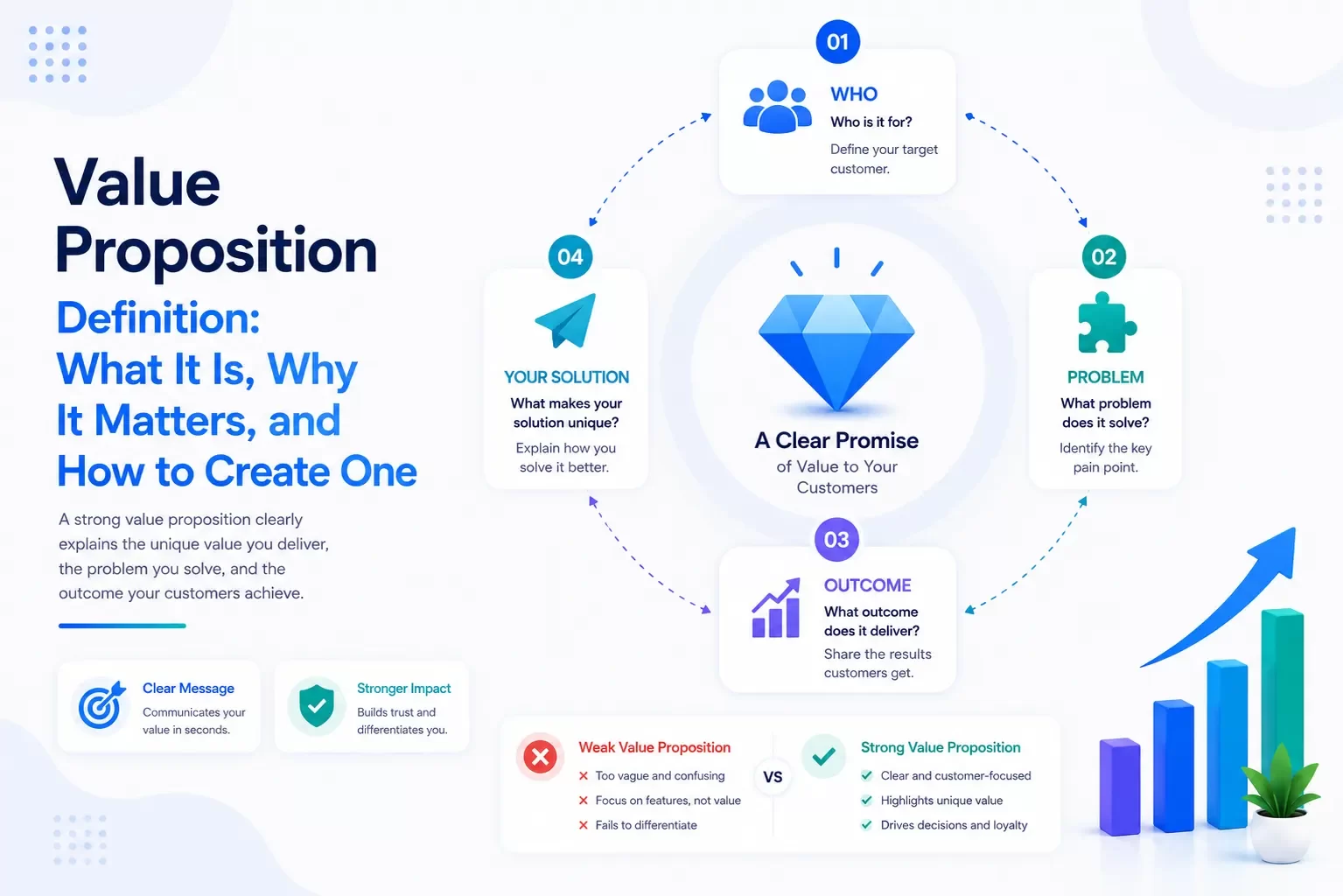
A value proposition is a concise statement that explains the unique benefits your product or service provides, the problem it solves, and why customers should choose your business over competitors.
An effective value proposition answers three essential questions:
- What problem do you solve?
- Who do you solve it for?
- Why is your solution better or different?
Rather than focusing only on product features, a value proposition emphasizes the outcomes customers can expect.
For example:
Weak value proposition: "We offer CRM software."
Strong value proposition: "Arches CRM helps growing businesses capture leads, automate follow-ups, and manage customer relationships in one platform, enabling teams to respond faster, stay organized, and close more deals."
The second example communicates the audience, the solution, and the customer benefit much more clearly.
Why Is a Value Proposition Important?
A strong value proposition influences nearly every aspect of your business. It helps customers quickly understand what you offer and why it matters, making it easier for them to decide whether your solution fits their needs.
An effective value proposition can help businesses:
- Differentiate themselves from competitors.
- Increase website conversions.
- Improve marketing effectiveness.
- Strengthen sales presentations.
- Build customer trust.
- Clarify messaging across teams.
- Improve customer acquisition.
- Support long-term brand positioning.
Without a clear value proposition, customers may struggle to understand what makes your business different.
Key Elements of a Strong Value Proposition
Target Audience
Clearly identify who your product or service is designed for.
Examples include:
- Small businesses
- Construction companies
- Real estate agencies
- Healthcare providers
- Marketing agencies
- Enterprise organizations
Knowing your audience helps you communicate relevant benefits.
Customer Problem
Every product should solve a meaningful problem.
Examples include:
- Slow lead response times
- Disorganized customer information
- Manual workflows
- Missed follow-ups
- Poor team collaboration
- Lack of sales visibility
Customers buy solutions, not features.
Your Solution
Explain how your product or service solves the customer's challenge. Focus on practical outcomes rather than technical specifications.
Unique Differentiators
Highlight what makes your solution different.
Examples may include:
- AI-powered automation
- Unified communication
- Faster implementation
- Lower cost
- Better customer support
- Industry-specific workflows
- Easier user experience
Differentiators should be meaningful to customers, not simply unique for the sake of being different.
Measurable Benefits
Whenever possible, explain the results customers can expect.
Examples include:
- Save time through automation.
- Improve team collaboration.
- Increase productivity.
- Respond to leads faster.
- Reduce manual work.
- Improve customer satisfaction.
If you use statistics or performance claims, ensure they are supported by reliable data or customer case studies.
How to Write a Value Proposition
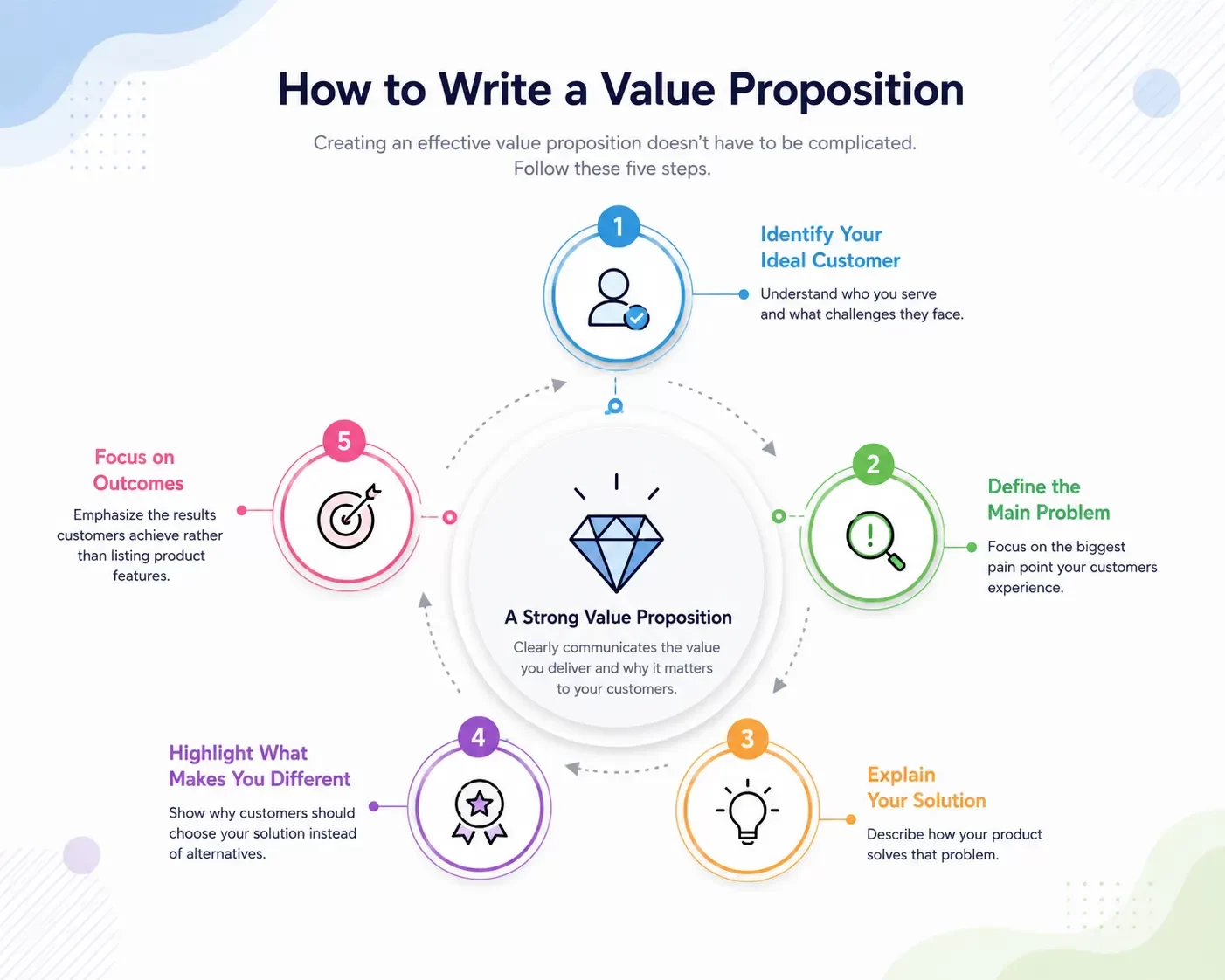
Creating an effective value proposition doesn't have to be complicated. Follow these five steps.
1. Identify Your Ideal Customer
Understand who you serve and what challenges they face.
2. Define the Main Problem
Focus on the biggest pain point your customers experience.
3. Explain Your Solution
Describe how your product solves that problem.
4. Highlight What Makes You Different
Show why customers should choose your solution instead of alternatives.
5. Focus on Outcomes
Emphasize the results customers achieve rather than listing product features.
Common Value Proposition Mistakes
Many businesses weaken their messaging by making avoidable mistakes. Common examples include:
- Using vague language.
- Focusing only on features.
- Trying to appeal to everyone.
- Ignoring customer pain points.
- Making unsupported claims.
- Copying competitors.
- Using excessive marketing jargon.
The best value propositions are clear, specific, and customer-focused.
Examples of Value Propositions
Example 1: CRM Software
"Arches CRM helps growing businesses centralize customer relationships, automate sales workflows, and improve team collaboration through one easy-to-use platform."
Example 2: Accounting Firm
"We help small businesses simplify accounting, reduce tax complexity, and gain financial clarity through proactive advisory services."
Example 3: Construction Company
"We deliver commercial construction projects on schedule and within budget through experienced project management and transparent communication."
Notice that each example focuses on customer outcomes rather than product features.
How Arches CRM Helps Businesses Deliver Their Value Proposition
Having a great value proposition is only the beginning. Businesses must consistently deliver on the promises they make. Arches CRM helps organizations do exactly that by providing the tools needed to manage customer relationships, automate repetitive tasks, and improve communication across teams.
Key capabilities include:
- Lead capture from multiple channels
- Customer relationship management
- Sales pipeline tracking
- Workflow automation
- Unified communication
- AI-powered productivity tools
- Task and project management
- Analytics and reporting
By centralizing customer information and streamlining operations, Arches CRM enables businesses to provide faster responses, better service, and more consistent customer experiences that reinforce their value proposition.
Best Practices for Creating a Strong Value Proposition
Keep these principles in mind when developing your messaging:
- Be customer-focused.
- Use simple language.
- Highlight benefits before features.
- Address real business problems.
- Support claims with evidence.
- Differentiate your business clearly.
- Test your messaging regularly.
- Update your value proposition as customer needs evolve.
A value proposition should grow alongside your business.
Conclusion
A value proposition is much more than a marketing statement. It is a promise that explains the value your business delivers and why customers should choose you over competing alternatives.
A clear value proposition improves marketing, strengthens sales conversations, supports customer acquisition, and builds long-term trust.
Combined with the right technology, such as Arches CRM, businesses can not only communicate their value effectively but also consistently deliver the customer experience that keeps clients coming back.