 Log in
 Start Free Trial

What is relationship intelligence?
Most small businesses have relationship data. Few have relationship intelligence.
- Relationship data is a name, a phone number, a company, maybe a last-contacted date.
- Relationship intelligence is the context: the owner prefers text over email, the renewal is in March, the last project ran over budget and they are still sore about it, and the CFO is the real decision-maker.
That context usually lives in someone's head. Relationship management software moves it into a record everyone can see, and keeps it current without relying on anyone to type it in.
Why does context disappear when staff leave?
Staff turnover is where small businesses feel relationship loss most. A rep or property manager leaves, and with them go:
- The history of every conversation that happened by phone
- Promises made verbally ("we will revisit pricing after the first year")
- The informal org chart at each account
- The timing of every renewal, expansion and referral opportunity
The replacement starts cold. Customers notice. Some quietly shop around.
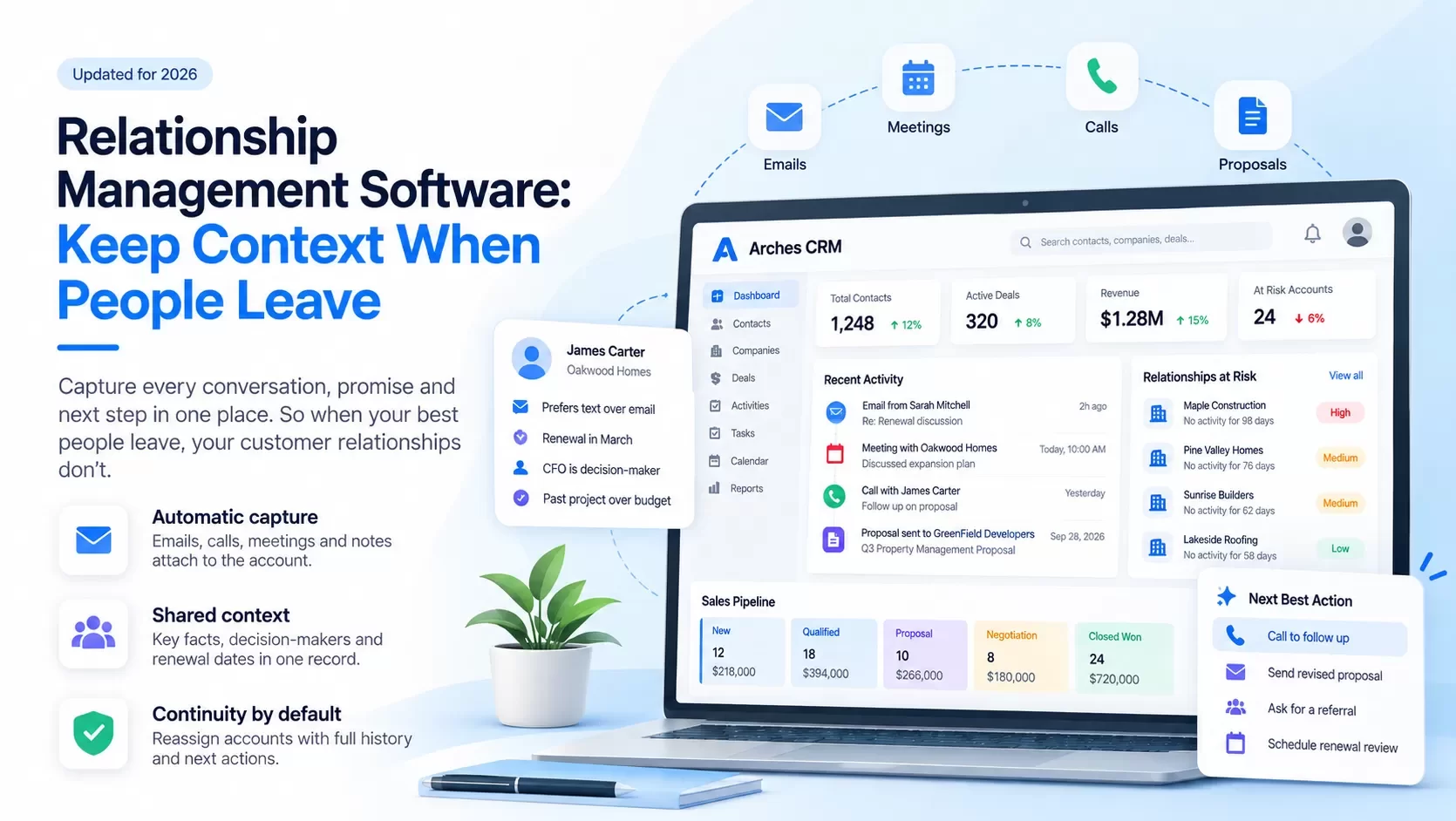
Good customer relationship management software for small business prevents this in three ways:
- Automatic capture. Emails, calendar events and meetings attach to the account without manual entry [CONFIRM: Arches email/calendar sync].
- Structured context. Key facts (decision-makers, renewal dates, preferences) live in fields, not free-text notes.
- Continuity by default. Reassigning an account moves the entire history and every open next action to the new owner.
CRM vs contact manager vs spreadsheet: what is the difference?
This is the most common question we hear from growing teams. Here is the honest comparison.
| Capability | Spreadsheet | Contact manager | CRM (relationship management software) |
|---|---|---|---|
| Stores names and contact details | Yes | Yes | Yes |
| Shared by the whole team in real time | Partly (version conflicts) | Sometimes | Yes |
| Full timeline of emails, calls and meetings | No | Limited | Yes, captured automatically |
| Tracks deals and pipeline stages | Manually | No | Yes |
| Next action with owner and due date | No | Basic reminders | Yes, with AI suggestions [CONFIRM: Arches AI next action live] |
| Proposals and follow-up | No | No | Yes [CONFIRM: Arches proposal + follow-up automation live] |
| Survives staff turnover | Rarely | Partly | Yes, history transfers with the account |
| Surfaces dormant relationships | No | No | Yes, with AI [CONFIRM: Arches dormant-account alerts live] |
| Reporting and forecasting | Manual formulas | No | Yes |
| Best for | One person, a few dozen contacts | Solo pros who need an address book | Any team that sells, renews or manages accounts |
The short version of CRM vs contact manager: a contact manager remembers who people are. A CRM remembers the relationship and tells you what to do next.
What does the AI do for relationships?
Two jobs matter most.
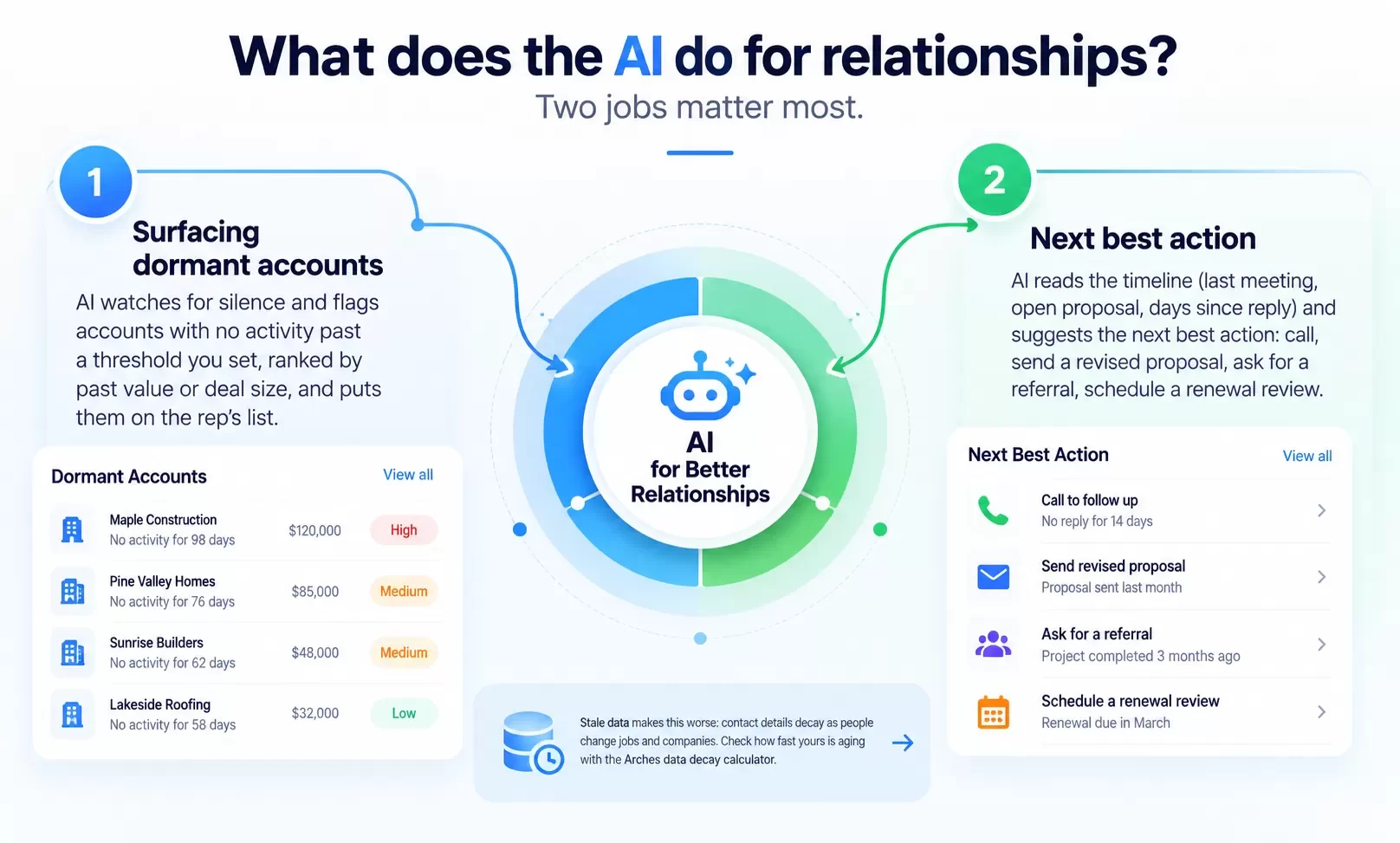
1. Surfacing dormant accounts
Every business has relationships that went quiet: a past customer who has not bought in 14 months, an owner who asked for a proposal and never replied, a referral partner who stopped sending work. Nobody notices, because nothing is on fire.
AI can watch for silence. Arches flags accounts with no activity past a threshold you set, ranked by past value or deal size, and puts them on the rep's list [CONFIRM: dormant-account detection live]. Silence becomes a task instead of a loss.
Stale data makes this worse: contact details decay as people change jobs and companies. Check how fast yours is aging with the Arches data decay calculator [CONFIRM: calculator live + URL].
2. Next best action
For every active relationship, the question is "what should happen next?" AI reads the timeline (last meeting, open proposal, days since reply) and suggests the next best action: call, send a revised proposal, ask for a referral, schedule a renewal review [CONFIRM: AI next best action live].
The rep stays in control. The AI removes the guesswork and the forgetting.
A property management scenario: owner-lead follow-up
Consider a property management company that manages single-family and small multifamily properties. Its growth depends on winning new owners, and owner leads take months to convert.
The situation. A business development manager, Sarah, has 60 open owner conversations. She leaves for another firm. Her replacement, Marcus, starts Monday.
Without relationship management software: Marcus inherits a spreadsheet with names, phone numbers and a "notes" column that says things like "call back later." He starts cold with 60 owners. Several already met with a competitor.
With Arches CRM:
| What Marcus sees on day one | Why it matters |
|---|---|
| Every owner's full timeline: calls, emails, walkthroughs, proposals sent | He knows what was said, not just who to call |
| Each owner's property details, unit count and current manager | He can speak to their situation immediately |
| Open proposals with open/view status [CONFIRM: proposal tracking live] | He knows who is warm |
| A ranked list of dormant owners with no touch in 30+ days [CONFIRM: dormant-account alerts live] | He calls the at-risk ones first |
| A next best action on every open deal [CONFIRM: AI next best action live] | He is productive by Tuesday |
| Automated follow-ups still running on schedule | No owner goes quiet during the handoff |
Sarah's relationships did not leave with Sarah. That is the whole point.
Property groups like New Earth Residential, Laguna Properties and Worth Street Properties use Arches to run their pipelines [CONFIRM: any specific outcome or quote].
Which relationship metrics should you track?
Relationship health is measurable. Track these four in your CRM, reviewed monthly:
| Metric | What it tells you | Warning sign |
|---|---|---|
| Days since last meaningful touch | Which accounts are drifting | Key accounts past 45 days |
| Open next actions per account | Whether every relationship has a plan | Any active account with none |
| Stakeholders per account | How exposed you are to one contact leaving | Only one named contact |
| Proposal response time | How engaged the buyer is | No reply within 7 days |
The third metric is the one most teams ignore. If your whole relationship with a customer runs through one person on their side, you are exposed to turnover at their company as much as yours. Good relationship management software makes it easy to log every stakeholder you meet and keep each one warm.
How to choose relationship management software
Use these questions in every demo:
- "Show me an account's full history without anyone typing." If it relies on manual entry, context will decay.
- "Reassign this account. What moves with it?" History, open tasks, sequences and proposals should all transfer.
- "Which of my accounts went quiet this month?" The system should answer without a custom report.
- "What is the next best action on this deal, and why?" The AI should explain its suggestion.
- "What does it cost for my whole team, year one?" Include onboarding, AI and any required add-ons.
For a full buyer's rubric and priced vendor comparison, see our guide to the best small business CRM software.
FAQ
What is relationship management software?
Software that stores the full context of each customer relationship, including history, people, promises and next steps, so the whole team can act on it.
Is relationship management software the same as a CRM?
Yes. CRM stands for customer relationship management. Modern CRMs add AI that surfaces dormant accounts and suggests next actions.
What is the difference between a CRM and a contact manager?
A contact manager stores contact details. A CRM stores the relationship: timeline, deals, next actions, proposals and follow-ups.
When should a small business move off a spreadsheet?
When more than one person manages customers, or when you cannot see the last conversation with an account in under a minute.
How does a CRM protect relationships during staff turnover?
By capturing activity automatically and transferring full history and open actions when an account is reassigned.
What is "next best action" in a CRM?
An AI suggestion for the most useful next step on a deal or account, based on its recent activity and stage.
Is Arches CRM a fit for property management?
Yes. Arches is used by property and real estate teams to manage owner leads, proposals and follow-up [CONFIRM: property-management-specific features or templates].
Internal link suggestions
- Best Small Business CRM Software: How to Pick, Price and Prove ROI
- What Is CRM? A Plain-English Definition and How Modern CRM Works
- All-in-One CRM for Small Business: Why One Platform Beats a Stitched Stack
LinkedIn teaser
When your best account manager leaves, does the relationship leave with them? It should not, and here is how to make sure.
Start closing deals
Keep every relationship. Stop managing your CRM. Start closing deals. Small team? Start your free trial of Arches CRM. 100+ employees? Book a demo and see how Arches keeps account context through team changes.