
 Log in
 Start Free Trial
Why does the sale not end at the signature?
Because the most profitable revenue in a service business comes after it.
Bain & Company's Fred Reichheld found that in financial services "a 5% increase in customer retention produces more than a 25% increase in profit" (Bain & Company, "Prescription for cutting costs"). The exact figure varies by industry, but the direction is not in dispute: keeping and expanding customers beats replacing them.
Contractors and service companies have a special advantage. Every finished job produces:
- A customer who can review you.
- Neighbors, owners or colleagues who saw the work.
- Future maintenance, warranty and upgrade needs.
Most small businesses leave all three on the table because the crew moves to the next job and nobody owns the follow-up.
What does good post-sale follow-up look like?
It is scheduled, specific and useful. Not "just checking in."
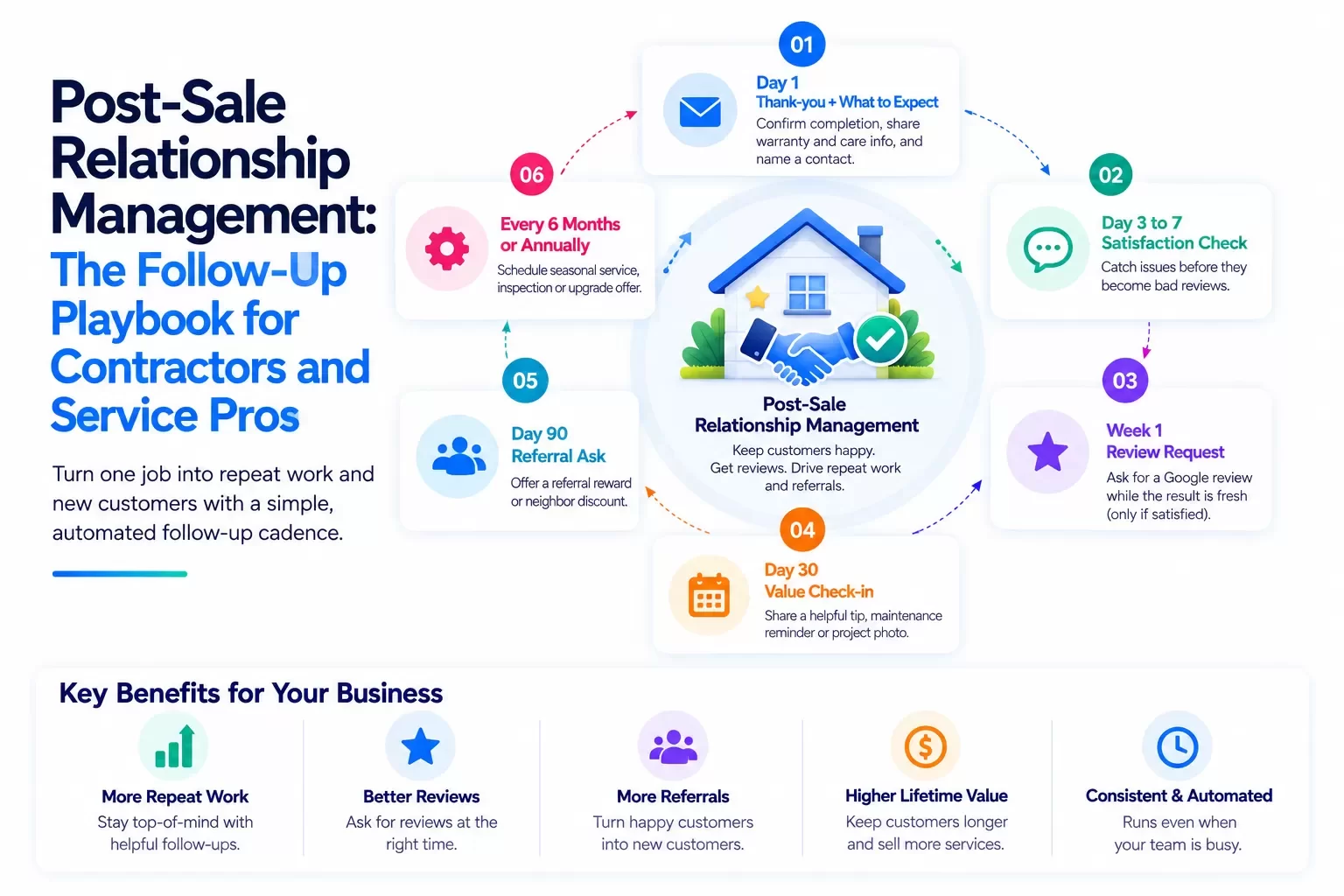
Here is the cadence we recommend as a starting template.
| When | Touchpoint | Message purpose | Channel | Automation |
|---|---|---|---|---|
| Day 1 | Thank-you + what to expect | Confirm completion, share warranty and care info, name a contact | Email + text | Triggered when job marked complete |
| Day 3 to 7 | Satisfaction check | Catch issues before they become bad reviews | Text or call | Auto-sent survey; low score creates a manager task |
| Week 1 (if satisfied) | Review request | Ask for a Google review while the result is fresh | Text with direct link | Sent only when survey score is high |
| Day 30 | Value check-in | Tip, maintenance reminder or photo follow-up | Scheduled sequence | |
| Day 90 | Referral ask | Offer a referral reward or neighbor discount | Email + text | Scheduled; paused if an open issue exists |
| Every 6 months | Seasonal service | Maintenance, inspection or seasonal prep offer | Email + text | Recurring, by service type |
| Annual | Anniversary + inspection | Annual inspection, warranty reminder, upgrade offer | Call or email | Creates a rep task for high-value customers |
Three rules:
- Never ask for a review before you ask about satisfaction. Fix problems first.
- Pause marketing when there is an open issue. Nothing destroys trust like a referral ask during a warranty claim.
- Make every touchpoint useful. A maintenance tip earns the right to the next message.
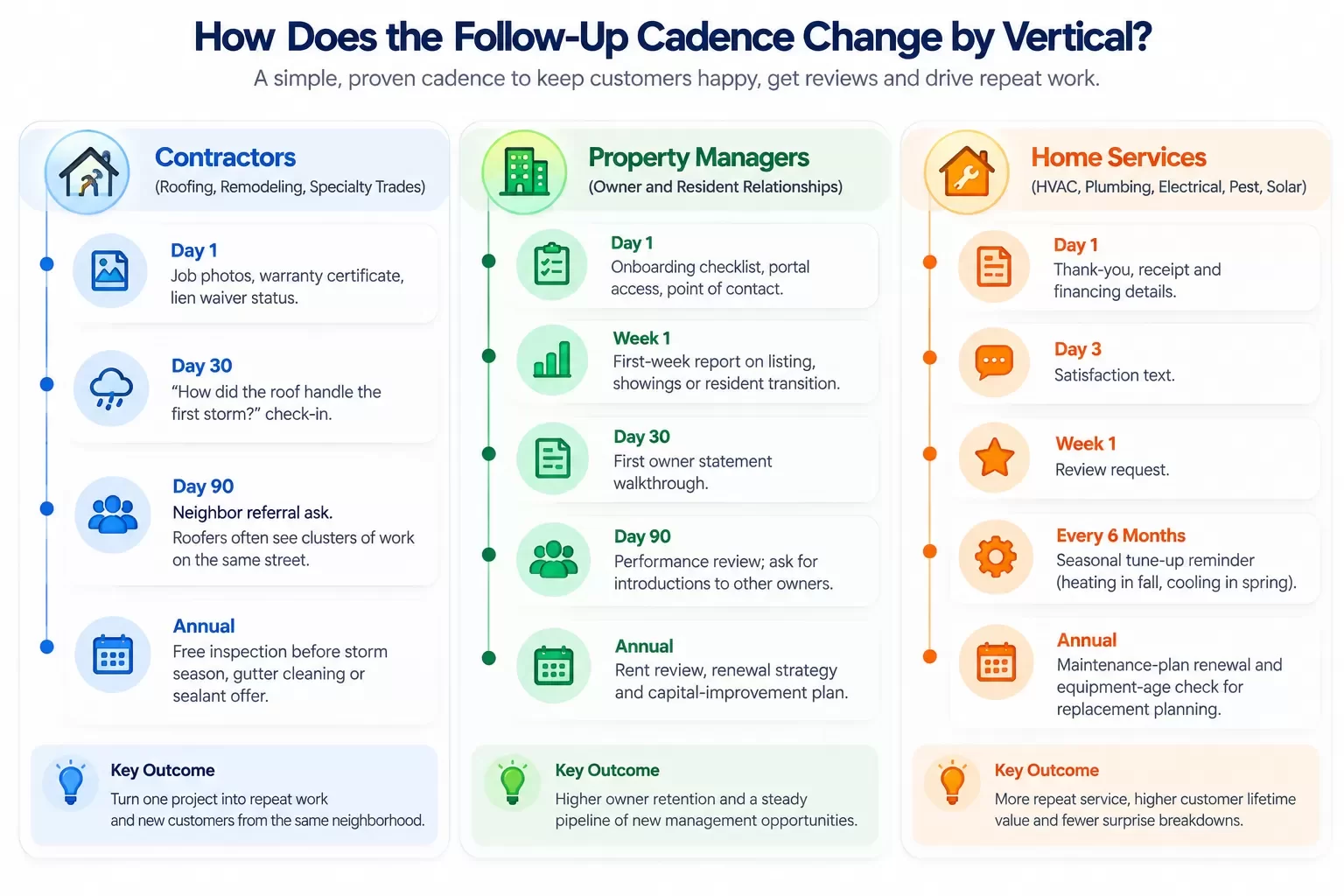
How does the cadence change by vertical?
Contractors (roofing, remodeling, specialty trades)
- Day 1: job photos, warranty certificate, lien waiver status.
- Day 30: "How did the roof handle the first storm?" check-in.
- Day 90: neighbor referral ask. Roofers often see clusters of work on the same street.
- Annual: free inspection before storm season, gutter cleaning or sealant offer.
Property managers (owner and resident relationships)
- Day 1 (new owner): onboarding checklist, portal access, point of contact.
- Week 1: first-week report on listing, showings or resident transition.
- Day 30: first owner statement walkthrough.
- Day 90: performance review; ask for introductions to other owners.
- Annual: rent review, renewal strategy and capital-improvement plan.
Owner retention is the entire business for a management company. One lost 50-unit owner can erase a quarter of new sales.
Home services (HVAC, plumbing, electrical, pest, solar)
- Day 1: thank-you, receipt and financing details.
- Day 3: satisfaction text.
- Week 1: review request.
- Every 6 months: seasonal tune-up reminder (heating in fall, cooling in spring).
- Annual: maintenance-plan renewal and equipment-age check for replacement planning.
The review and referral loop
Reviews and referrals are one loop, not two campaigns.
- Job complete → thank-you sent automatically.
- Satisfaction check → score captured on the customer record.
- High score → review request with a one-tap link.
- Review posted → personal thank-you; customer tagged as a promoter.
- Promoter at day 90 → referral ask with a clear reward.
- Referral arrives → new lead is linked to the referring customer, so you can thank them and track referral revenue.
- Low score at any step → manager task within 24 hours; marketing pauses until resolved.
Vertical scenario: an HVAC company's loop. A 15-truck HVAC company completes about 250 installs and repairs a month. With the loop running, every job triggers the sequence automatically. The service manager only touches two moments: low-score recovery calls and referral thank-yous. Everything else runs on schedule.
Retention math: what is post-sale follow-up worth?
Clearly hypothetical numbers for a residential HVAC company. Replace with yours.
Starting point
| Input | Value |
|---|---|
| Completed jobs per year | 3,000 |
| Average first-job value | $900 |
| Customers who buy again within 24 months (no program) | 20% |
| Average repeat spend per returning customer | $1,200 |
| Customers who refer someone (no program) | 3% |
| Average referred job value | $900 |
With a structured post-sale program
| Metric | Without program | With program | Difference |
|---|---|---|---|
| Repeat customers | 600 (20%) | 900 (30%) | +300 |
| Repeat revenue | $720,000 | $1,080,000 | +$360,000 |
| Referring customers | 90 (3%) | 240 (8%) | +150 |
| Referral revenue | $81,000 | $216,000 | +$135,000 |
| Total post-sale revenue | $801,000 | $1,296,000 | +$495,000 |
At a 40% gross margin, that is about $198,000 in added gross profit, with no new ad spend. Even if your lift is half of this example, the program pays for itself many times over.
What does AI add to post-sale relationship management?
Cadences handle the predictable moments. AI handles the signals humans miss.
| Signal | What the AI notices | Action it triggers |
|---|---|---|
| Churn risk | Customer stopped opening emails, skipped last tune-up, or left a lukewarm survey comment | Flags the account and creates a personal call task [CONFIRM: AI churn-risk scoring live] |
| Referral readiness | High satisfaction score, positive review, repeat purchase | Moves the customer into a referral ask early [CONFIRM: AI referral triggers live] |
| Upsell timing | Equipment age, service history or contract end date | Suggests the next offer and timing [CONFIRM: AI next-action on customer records live] |
| Sentiment in notes | Technician or call notes mention frustration | Alerts the manager before a bad review [CONFIRM: AI sentiment detection on notes/calls live] |
What the AI does, concretely: a property owner's last two monthly statements went unopened and the owner's reply to a maintenance request was one word. Arches flags the owner as at-risk, summarizes the last 90 days of interactions for the account manager, and suggests a call before the renewal window [CONFIRM: all three AI actions live].
That is Sales Made Simple after the sale: keep every conversation, know the next action, follow up automatically.
How to launch a post-sale program in 30 days
- Week 1: define the "job complete" trigger in your CRM and write the Day 1 and satisfaction messages.
- Week 2: set up the review request with your direct Google review link and the low-score escalation.
- Week 3: write 30-day, 90-day and seasonal messages for your top two service types.
- Week 4: add referral tracking (source = referring customer) and a monthly report: reviews gained, repeat revenue, referral revenue.
If you use separate tools for jobs, email and reviews, this is where a unified platform pays off. No fragmented tools.
FAQ
What is post-sale relationship management?
It is the planned set of follow-ups after a sale, such as thank-yous, satisfaction checks, review and referral requests, service reminders and renewals, that keeps customers buying and referring.
How soon should I follow up after a job?
Within 24 hours with a thank-you and what to expect, then a satisfaction check in 3 to 7 days, before any review request.
How do small businesses improve customer retention?
Use a fixed touchpoint cadence, make each message useful, fix issues fast, and track repeat and referral revenue per customer.
When should I ask for a referral?
After the customer has confirmed satisfaction and ideally left a review, typically around 90 days, and never during an open issue.
Should post-sale follow-up be automated?
Yes for timing and routine messages. Keep humans on recovery calls, high-value renewals and personal thank-yous.
How does AI help with retention?
It spots churn and referral signals in engagement, surveys and notes, then triggers the right action. In Arches CRM these signals appear on the customer record [CONFIRM: AI churn/referral features live].
Internal link suggestions
- Sales Pipeline Management for Small Business: Stages, Coverage and Forecasts That Hold Up
- Best CRM With Email Marketing for Small Business: 2026 Comparison
- Mobile CRM App for Small Business: A Field-First Buying Guide
- Link retention math to the Arches campaign ROI calculator [CONFIRM: calculator live + URL]
LinkedIn teaser
Your next $495K might already be in your customer list. Here is the post-job follow-up cadence contractors and service pros should run.
Start closing deals
Small team? Start your free trial of Arches CRM and switch on your first post-job follow-up sequence.
Team of 100+? Book a demo and we will design your post-sale cadence with you.