
 Log in
 Start Free Trial


You see a financial return from CRM software when the value of attributable time savings and additional sales profit exceeds the full cost of implementation and use—not simply when the system goes live. For a 2026 rollout, base your payback forecast on your own sales cycle, adoption, and workflow improvements, including setup and training effort in the calculation.
- How long does it take to see ROI from CRM software? Your break-even point depends on verified benefits exceeding costs.
- Arches CRM suits growing sales teams that need shared conversations, pipeline tracking, and automated follow-ups.
- Track CRM payback separately from adoption: completed training and cleaner records are progress, not financial returns.
- Count additional sales profit and usable time savings without counting the same benefit twice.
Why this matters
A lead arrives, nobody owns the next step, and the conversation stalls. A CRM gives you a way to assign ownership and trigger follow-up, but buying software does not prove that the missed opportunity has been fixed.
Arches CRM is best suited to growing sales teams that need pipeline tracking and follow-up automation in one place. Arches CRM brings contacts, conversations, tasks, and sales activity together; your return still depends on whether your team changes how it handles those leads.
Set a 2026 investment decision around a measurable operating problem. “Reduce unassigned leads” gives you something to verify; “improve sales” leaves too much room for interpretation.
How long does it take to see ROI from CRM software?
Your CRM pays back when cumulative, attributable benefits cover cumulative costs. The calendar date comes from your business records, not from the software category.
You can see operational progress before you see financial payback. A follow-up task created correctly proves that a workflow runs; it does not prove that the workflow generated additional profit.
Use these checkpoints to distinguish implementation progress from a return:
| Checkpoint | What you verify | What it establishes | What it does not establish |
|---|---|---|---|
| Working setup | Leads, owners, conversations, and tasks are recorded correctly | The process is ready to use | That the team consistently uses it |
| Consistent adoption | Reps maintain records and complete the intended actions | The workflow is operating | That it improves outcomes |
| Operational improvement | Comparable work takes less effort or fewer leads miss follow-up | A measurable process benefit | That every improvement creates cash savings |
| Financial break-even | Attributable benefits cover cumulative costs | The investment has paid back under your accounting method | That future returns are guaranteed |
The practical answer is to forecast from an observed benefit rate, then update the forecast as results arrive. Do not turn a target date into a claimed outcome.
Calculate payback without confusing it with ROI
ROI measures the size of the return relative to the investment. Payback measures how long it takes to recover that investment.
Use these calculations consistently:
- Net benefit: Attributable benefits minus total CRM costs over the same period.
- ROI: Net benefit divided by total CRM costs, expressed as a percentage.
- Payback date: The point when cumulative attributable benefits equal cumulative costs.
A forward estimate can divide unrecovered implementation costs by the expected recurring net benefit. That shortcut assumes a stable benefit rate; it is not useful while adoption and results are still changing materially.
Time savings: verify capacity before calling it cash
Time savings provide an operating signal that does not require a deal to close. Compare the effort required for the same task before and after the workflow changes, using comparable records and work conditions.
Email summaries, shared conversation history, and automated reminders are relevant tasks to evaluate. Record the work actually removed, including any checking or correction that replaces the original task.
Freed capacity is not automatically a reduction in spending. If a rep spends less time updating records but payroll remains unchanged, report the result as capacity gained unless you can connect it to another financial benefit.
Use the released capacity deliberately. Assign it to prospect follow-up, account reviews, or another defined activity, then measure the outcome rather than assuming every saved minute becomes revenue.
Sales gains: follow the lead through to profit
Sales-related returns require evidence beyond more messages or more activity. Track whether comparable leads progress, close, and produce additional profit after the workflow changes.
Your own sales cycle determines when that evidence becomes available. If an opportunity has not reached a buying decision, its projected value remains a forecast rather than a realized return.
Separate new leads from opportunities already near completion when the CRM launched. Otherwise, deals that were likely to close anyway can make the implementation appear more productive than it was.
For your 2026 reporting, keep lead sources and qualification rules visible. A change in lead quality can affect conversion independently of the CRM, so a higher close rate alone does not establish causation.
Cost recovery: include the work around the software
The investment includes more than the software subscription. Your calculation needs the implementation effort and ongoing work required to keep the process useful.
Include applicable costs for:
- Data cleanup, import preparation, and migration work.
- Workflow configuration and integration work.
- Training, internal documentation, and team support.
- Administration, troubleshooting, and workflow maintenance.
- Overlapping systems retained during the transition.
Include internal labor using a consistent valuation method. Leaving that effort out shortens the apparent payback period without improving the underlying economics.
Keep one-time implementation work separate from recurring operating costs. That distinction helps you identify whether delayed payback comes from the initial project, ongoing overhead, or benefits that have not materialized.
Why CRM payback time varies
CRM payback varies because businesses start with different problems, workflows, and sales cycles. Evaluate these factors before committing to a forecast:
- Sales cycle: Revenue evidence depends on when the affected opportunities reach a decision, not just when automation starts.
- Adoption: A workflow cannot produce its intended result when reps continue managing conversations outside the agreed process.
- Data quality: Duplicate contacts, missing owners, and incomplete history make assignment and reporting harder to trust.
- Implementation scope: Each added workflow or integration introduces work that belongs in the investment calculation.
- Existing process gaps: Fixing a documented missed follow-up gives you a clearer measurement target than a broad promise of better productivity.
- Measurement discipline: Changes in lead sources, staffing, or qualification can obscure which outcomes belong to the CRM project.
Fix the process you can measure before expanding the rollout. A narrower scope makes it easier to understand what changed and whether the result justifies further work.
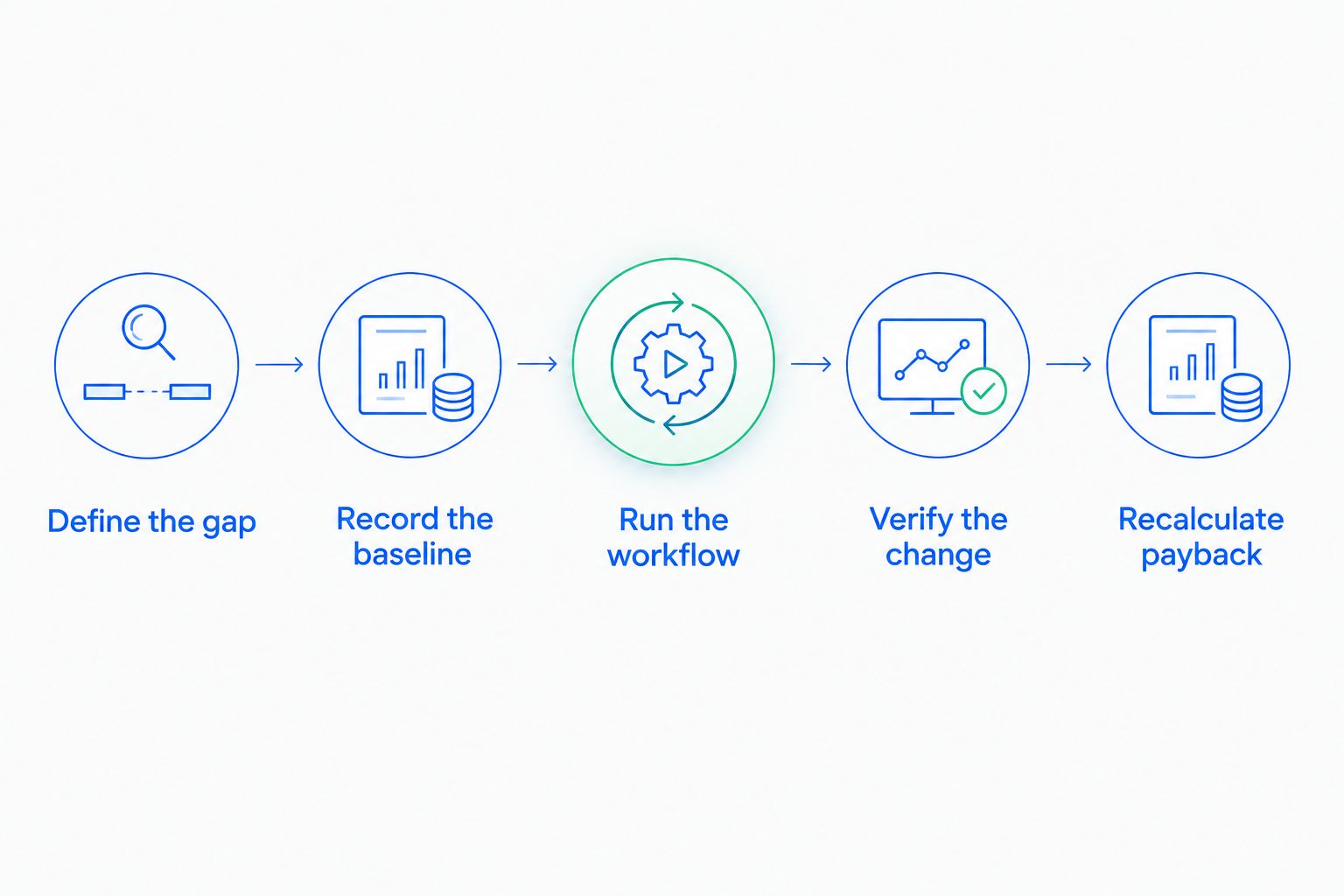
How do you build a credible CRM payback forecast?
Start with the sales problem, not a preferred return date. Build a forecast that another person can trace back to records, assumptions, and a consistent accounting method.
Define the gap
Choose a problem such as leads without an owner, overdue follow-ups, or time spent reconstructing conversations. State the outcome you want and identify the record that will show whether it happened.
Avoid bundling unrelated goals into one claim. Better record quality and additional closed deals need different evidence, even when the same implementation supports both.
Record the baseline
Measure the existing process over a representative period before changing it. Use consistent definitions for a qualified lead, completed follow-up, and closed deal.
Document unusual conditions that affect comparisons. A campaign change or staffing change should remain visible rather than disappearing into a headline improvement.
Run the workflow
Implement the smallest workflow that addresses the gap. For a missed follow-up problem, define the owner, trigger, next action, and condition that stops the sequence.
A guide to automatically following up when a lead goes cold is relevant when stalled conversations are the specific problem you are trying to fix.
Verify the change
Check both execution and outcome. Confirm that the workflow handled the intended records, then compare the resulting work or sales performance against the baseline.
Review exceptions as well as successful runs. Incorrect assignments, unnecessary messages, and manual corrections belong in the assessment because they consume effort too.
Recalculate payback
Update cumulative benefits and costs using the same method throughout the review. Label estimated future benefits separately from benefits already observed.
Keep the assumptions attached to your 2026 forecast. If the expected benefit rate changes, revise the date instead of preserving an outdated promise.
Which benefits should you count toward CRM ROI?
Choose a measurement approach that matches the decision you need to make. Financial payback and operating capacity answer different questions, so report them separately when the evidence differs.
| Approach | Best for | Advantage | Limitation |
|---|---|---|---|
| Cash-only payback | Budget decisions | Uses realized financial changes | Excludes useful capacity that has not changed cash flow |
| Capacity assessment | Team workload decisions | Shows time released for other work | Does not establish additional profit by itself |
| Incremental profit assessment | Sales investment decisions | Connects outcomes to financial value | Requires careful attribution and comparable leads |
Do not count the same benefit twice. If saved administrative time enables additional selling activity, avoid treating both the full value of that time and all resulting profit as independent gains without an accounting rationale.
Use additional profit rather than total deal revenue when evaluating sales returns. Revenue brings delivery costs with it; treating the entire contract value as benefit overstates the return.
Where Arches CRM fits
Arches CRM supports lead assignment, pipeline tracking, workflow automation, and shared customer communications. Those functions fit a payback project focused on missed follow-ups, fragmented conversation history, or manual updates.
The trade-off is implementation and operating discipline. You still need accurate records, configured workflows, and a team that follows the agreed process; software features alone do not establish a return.
Evaluate the workflow against your gap before expanding it. A feature earns its place when it removes documented work or supports a measurable sales outcome.
Can CRM software show value before a deal closes?
Operational value can appear before financial payback. You can verify that leads receive owners, reminders trigger correctly, and conversation history is easier to review without waiting for a buying decision.
Keep those findings in an operational scorecard. Move them into the financial calculation only when you have a defensible valuation or a realized financial effect.
Does CRM automation guarantee a faster return?
CRM automation does not guarantee a faster return. It executes configured actions, so the result depends on whether those actions address the right problem and use accurate information.
Review stop conditions carefully. A follow-up sequence should reflect replies and deal status rather than continue simply because its original trigger fired.
When should you change a CRM rollout that is not paying back?
Change the rollout when the evidence identifies a broken assumption or workflow. Low adoption calls for a different response than correct execution with no measurable improvement.
Inspect the sequence: usable records, correct execution, changed behavior, and financial effect. Fix the failed link before adding more automation.
FAQ
How long does it take to see ROI from CRM software?
CRM software reaches financial break-even when cumulative attributable benefits cover cumulative implementation and operating costs. Forecast that date using your own sales cycle, observed workflow improvements, and full costs rather than a generic timeline.
Can I see CRM benefits before my sales cycle ends?
You can verify operational benefits before your sales cycle ends, including completed follow-ups and reduced administrative work. Those findings do not establish additional sales profit until the affected opportunities produce measurable outcomes.
What's the difference between CRM ROI and payback?
CRM ROI measures net benefit relative to investment, while payback measures the time required to recover the investment. Use the same cost scope and attribution rules for both calculations.
Should I count saved employee time as CRM ROI?
Count saved employee time as capacity gained unless it produces a defensible financial benefit. Payroll does not fall simply because a task takes less time, so report cash savings and released capacity separately.
Does a higher close rate prove the CRM is working?
A higher close rate alone does not prove that the CRM caused the improvement. Compare lead quality, sources, qualification rules, and other changes before attributing additional profit to the software.
What should I measure first after a CRM rollout?
Measure whether the intended workflow executes correctly and whether the team uses it. Then assess changes in follow-up, administrative effort, and sales outcomes against the baseline.
Is Arches CRM relevant if missed follow-ups are the problem?
Arches CRM supports lead management, reminders, tasks, and follow-up sequences, making it relevant to a missed-follow-up workflow. Define ownership and completion rules, then measure whether fewer leads miss their next action.
One last thing
A busier pipeline is not proof of a better investment. More tasks, messages, and recorded opportunities show activity; they do not establish additional profit.
Before approving more automation in 2026, ask a narrower question: which documented sales problem has improved, and what is that improvement worth? If the answer depends entirely on forecast revenue, keep the return labeled as a forecast.