 Log in
 Start Free Trial
Introduction
Customer relationships are the foundation of every successful business. Whether you're generating leads, managing sales opportunities, providing customer support, or nurturing long-term clients, keeping track of every interaction can quickly become challenging as your business grows.
Many businesses start by managing contacts in spreadsheets, email inboxes, or notebooks. While these methods may work initially, they become increasingly inefficient as the number of customers, employees, and communication channels expands. Information gets lost, follow-ups are forgotten, and valuable opportunities slip through the cracks.
This is where a CRM tool becomes essential. A Customer Relationship Management (CRM) tool helps businesses organize customer information, manage sales pipelines, automate repetitive tasks, centralize communication, and improve collaboration across teams. Instead of switching between multiple applications, employees work from a single platform that provides complete visibility into every customer relationship.
In this guide, you'll learn what a CRM tool is, how it works, its key features, the benefits it provides, and why businesses choose platforms like Arches CRM to streamline operations and drive growth.
What Is a CRM Tool?
A CRM tool is software designed to help businesses manage interactions with prospects, customers, and partners throughout the entire customer lifecycle. Rather than storing customer information across spreadsheets, emails, and multiple applications, a CRM tool centralizes all customer data into one secure platform.
This allows sales, marketing, customer service, and management teams to access the same information, collaborate more effectively, and deliver a consistent customer experience.
A modern CRM tool typically includes:
- Contact management
- Lead management
- Sales pipeline tracking
- Task management
- Calendar scheduling
- Communication history
- Workflow automation
- Reporting and analytics
- Document management
- Team collaboration
The result is better organization, improved productivity, and stronger customer relationships.
Why Businesses Need a CRM Tool
As companies grow, managing customer information manually becomes increasingly difficult. Without a CRM tool, businesses often encounter problems such as:
- Lost leads
- Missed follow-up opportunities
- Duplicate customer records
- Disconnected communication
- Poor visibility into the sales pipeline
- Inaccurate forecasting
- Time-consuming manual processes
- Limited collaboration between departments
A CRM tool eliminates these challenges by creating a single source of truth for customer data and business activities.
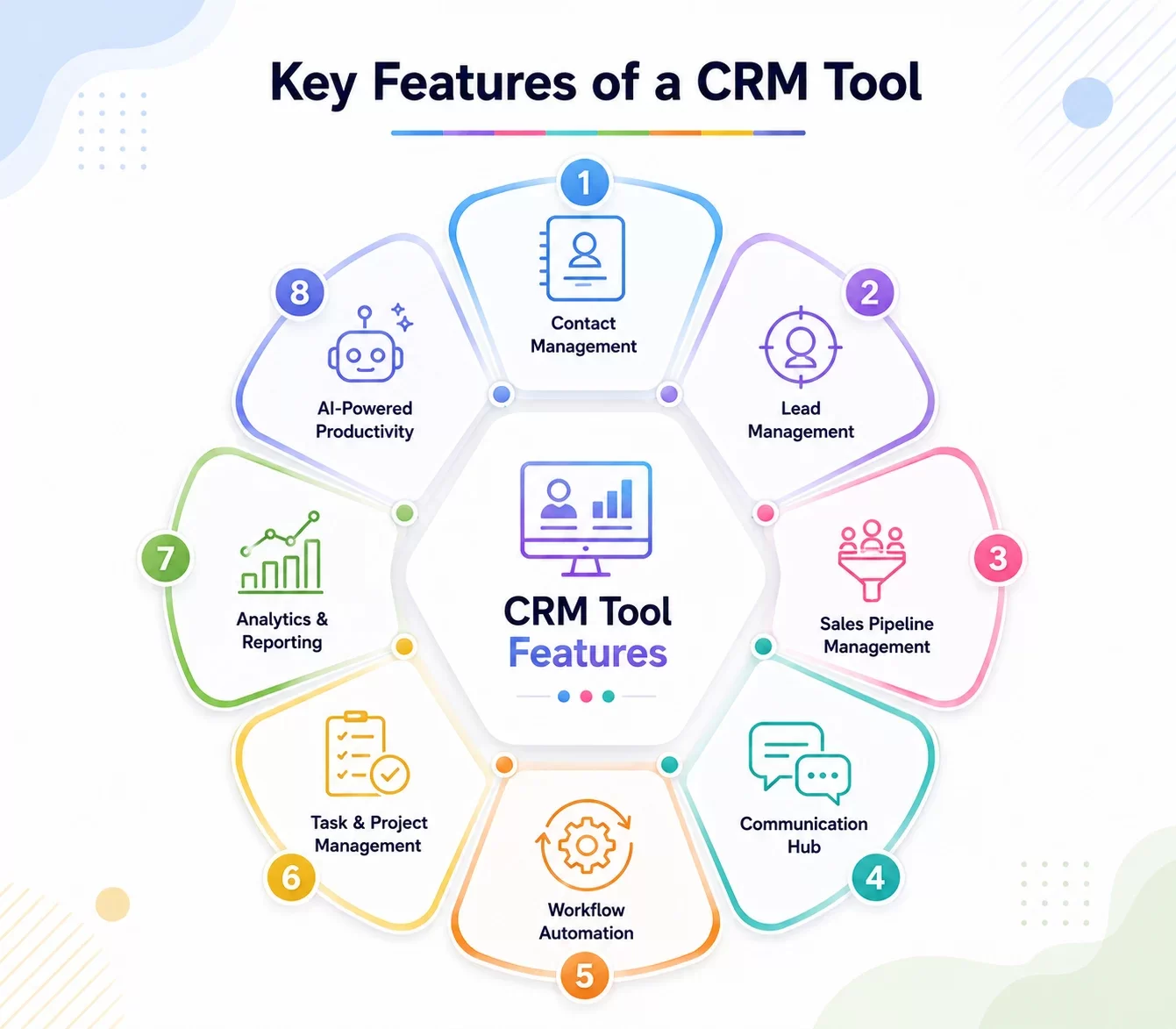
Key Features of a CRM Tool
Contact Management
Store customer contact details, notes, documents, communication history, and account information in one centralized location.
Lead Management
Capture leads from multiple sources, qualify prospects, assign leads automatically, and track their progress throughout the sales process.
Sales Pipeline Management
Visualize every opportunity using customizable sales pipelines that make it easy to monitor deal progress, identify bottlenecks, and forecast revenue.
Communication Hub
Manage customer interactions through email, WhatsApp, SMS, phone calls, and internal notes while maintaining a complete communication history.
Workflow Automation
Automate repetitive tasks such as follow-up reminders, email sequences, lead assignments, approval workflows, and notifications to save time and reduce manual effort.
Task and Project Management
Assign tasks, monitor project progress, schedule appointments, and ensure accountability across teams.
Analytics and Reporting
Track key performance indicators (KPIs), conversion rates, sales performance, revenue forecasts, and employee productivity through real-time dashboards.
AI-Powered Productivity
Modern CRM tools increasingly include artificial intelligence to assist with drafting emails, summarizing meetings, suggesting follow-up actions, identifying sales opportunities, and generating business insights.
Benefits of Using a CRM Tool
Implementing a CRM tool can improve nearly every aspect of customer relationship management. Key benefits include:
- Faster response to customer inquiries
- Improved customer satisfaction
- Better team collaboration
- Higher sales productivity
- Reduced manual administrative work
- Increased visibility into business performance
- More accurate sales forecasting
- Stronger customer retention
- Scalable business processes
- Better decision-making through data
By centralizing information and automating routine activities, teams spend more time building relationships and less time searching for information.
Who Uses CRM Tools?
CRM tools are valuable across many industries and departments. Common users include:
- Sales teams
- Marketing departments
- Customer support teams
- Real estate agencies
- Construction companies
- Insurance agencies
- Healthcare organizations
- Financial advisors
- Manufacturing companies
- Professional service firms
- Property management companies
- Small and medium-sized businesses
Regardless of industry, any organization that manages customer relationships can benefit from a CRM platform.
How Arches CRM Helps Businesses
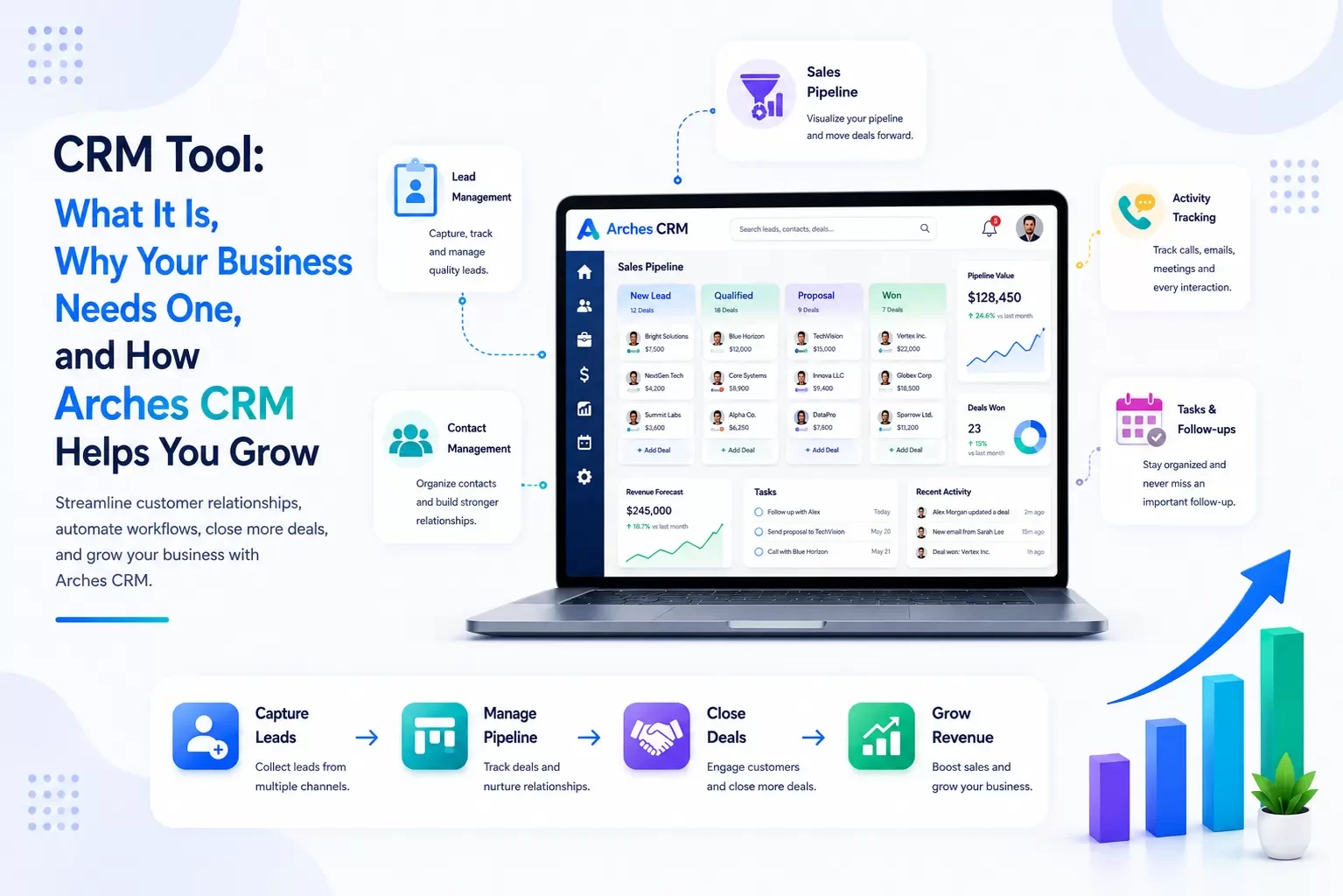
Arches CRM is an all-in-one CRM tool designed to simplify customer relationship management while improving efficiency across the entire organization.
Lead Capture
Automatically capture leads from websites, Facebook Lead Ads, Google Lead Forms, WhatsApp, email, phone calls, and other integrated channels.
Unified Communication
Bring together email, WhatsApp, SMS, phone logs, and customer conversations into one centralized workspace.
Pipeline Management
Track opportunities through customizable sales pipelines with drag-and-drop stages and real-time reporting.
Workflow Automation
Automate follow-ups, reminders, task assignments, lead routing, and recurring business processes.
AI Assistance
Use AI to generate emails, summarize customer interactions, create follow-up messages, and provide actionable sales insights.
Reporting
Monitor sales activity, pipeline performance, team productivity, and business growth using interactive dashboards and custom reports.
Team Collaboration
Enable departments to work together using shared customer records, tasks, calendars, documents, and activity histories.
Choosing the Right CRM Tool
When evaluating CRM software, businesses should consider several important factors:
- Ease of use
- Scalability
- Automation capabilities
- Integration options
- Mobile accessibility
- Reporting features
- AI capabilities
- Security
- Customer support
- Total cost of ownership
The right CRM should support your current processes while providing the flexibility to grow with your business.
Conclusion
A CRM tool is no longer just software for managing contacts—it's a platform that helps businesses organize customer relationships, improve collaboration, automate workflows, and make better decisions.
As customer expectations continue to rise, organizations need systems that enable fast responses, accurate information, and seamless communication across every department.
Arches CRM brings together lead management, pipeline tracking, communication, automation, analytics, and AI-powered productivity into one unified platform, helping businesses simplify operations, strengthen customer relationships, and drive sustainable growth.