
 Log in
 Start Free Trial
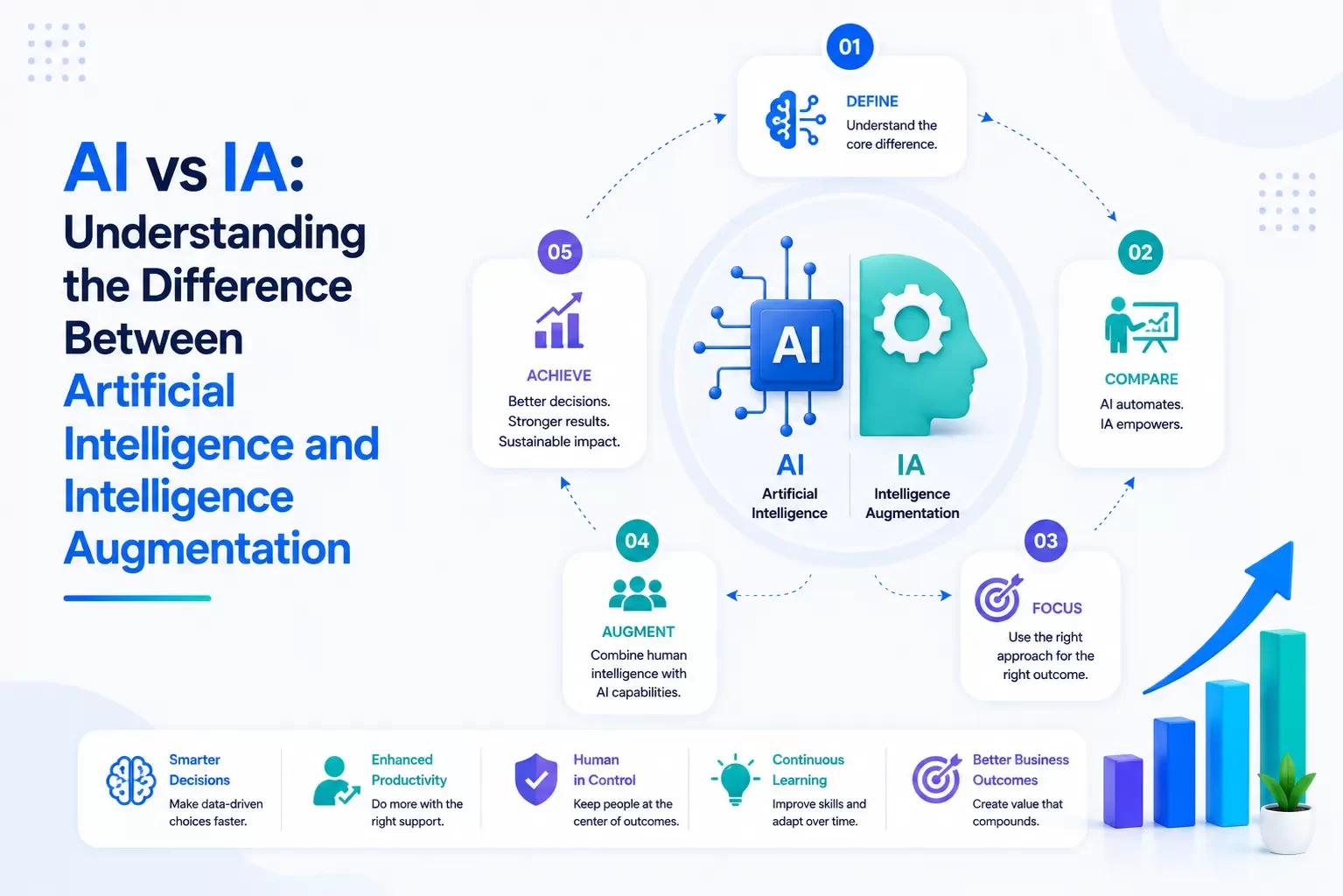
Artificial Intelligence (AI) has become one of the most talked-about technologies of the decade. Businesses across every industry are investing in AI-powered solutions to automate workflows, reduce costs, improve customer experiences, and gain a competitive advantage. Yet, amid all the excitement surrounding AI, another concept is quietly becoming just as important—Intelligence Augmentation (IA).
Although the terms AI and IA are often used interchangeably, they represent two fundamentally different approaches to improving business performance. AI aims to perform tasks that traditionally required human intelligence, while IA focuses on empowering people to make better decisions by combining human expertise with intelligent technology.
For business leaders, understanding this distinction is more than a matter of terminology. It influences technology investments, workforce strategies, customer experiences, and long-term business outcomes. Organizations that understand when to automate and when to augment their employees are often better positioned to achieve sustainable growth than those pursuing automation alone.
In this article, we'll explore what AI and IA are, how they differ, where each technology excels, and how businesses can use both together to create smarter, more effective operations.
What Is Artificial Intelligence (AI)?
Artificial Intelligence refers to computer systems that can perform tasks requiring human intelligence. These tasks include learning from data, recognizing patterns, understanding language, generating content, making predictions, and even making autonomous decisions. Unlike traditional software, which follows predefined rules, AI continuously improves as it processes additional information. Machine learning algorithms, deep learning models, computer vision, and natural language processing all fall under the umbrella of artificial intelligence.
Today, AI is used across virtually every industry. A customer service chatbot can answer thousands of customer questions simultaneously. A fraud detection system can identify suspicious financial transactions in milliseconds. A sales platform can predict which prospects are most likely to purchase based on historical behavior. Healthcare organizations use AI to analyze medical images, while manufacturers use predictive maintenance algorithms to prevent equipment failures before they occur.
The primary objective of AI is automation. It seeks to perform repetitive, data-driven, and increasingly complex tasks with minimal human involvement. When implemented correctly, AI enables organizations to increase productivity, reduce operational costs, minimize human error, and scale operations more efficiently.
However, AI is not without limitations. While it excels at processing large volumes of information and identifying patterns, it often lacks contextual understanding, emotional intelligence, ethical judgment, and the nuanced decision-making that humans naturally possess.
What Is Intelligence Augmentation (IA)?
Intelligence Augmentation takes a different approach. Rather than replacing people, IA is designed to enhance human intelligence. The goal of IA is not to automate humans out of the process but to make them better at what they already do. IA systems provide recommendations, summarize information, identify trends, highlight risks, and surface insights that help people make more informed decisions.
Think of IA as a highly intelligent assistant rather than an autonomous replacement. For example, a salesperson using an IA-powered CRM may receive recommendations on which prospect to contact first, suggested responses to customer objections, and reminders about previous conversations. The salesperson still builds the relationship and closes the deal, but technology provides valuable guidance throughout the process.
Similarly, a doctor may use IA to identify possible diagnoses based on medical imaging and patient history. The physician reviews those recommendations alongside their own clinical expertise before making the final diagnosis. In these scenarios, technology supports human judgment instead of replacing it.
The philosophy behind IA recognizes that humans possess qualities machines cannot easily replicate—creativity, empathy, ethical reasoning, intuition, negotiation skills, leadership, and relationship building. IA enhances these uniquely human capabilities by providing timely, data-driven insights.
AI vs. IA: Understanding the Core Difference
Although both AI and IA leverage advanced technologies such as machine learning and data analytics, their objectives differ significantly. Artificial Intelligence focuses on replacing or automating tasks traditionally performed by humans. Intelligence Augmentation focuses on improving the performance of humans by providing intelligent support.
This distinction becomes particularly important in business environments. An AI-powered system might automatically approve or reject loan applications based on predefined criteria and predictive models. An IA-powered system might instead analyze the applicant's financial profile, identify risk factors, compare similar cases, and provide recommendations that assist a loan officer in making a well-informed decision. One removes humans from the workflow. The other strengthens human decision-making.
Neither approach is inherently better. Their effectiveness depends entirely on the problem being solved.
A Simple Analogy
Imagine driving a car. Artificial Intelligence is comparable to a fully autonomous self-driving vehicle. The vehicle makes decisions independently with little or no driver involvement. Intelligence Augmentation resembles advanced driver assistance technologies such as lane departure warnings, adaptive cruise control, collision detection, and navigation systems. The driver remains in control while technology continuously improves safety, awareness, and decision-making. Both approaches deliver value—but they serve different purposes.
Why Businesses Often Get It Wrong
Many organizations assume automation is the answer to every operational challenge. In reality, attempting to automate complex decisions too early often creates frustration, poor customer experiences, and unnecessary risk.
Successful organizations begin by asking an important question: "Does this process require human judgment?" If the answer is no, AI may be the ideal solution. If the answer is yes, IA often produces significantly better outcomes.
Consider customer service. Simple password resets, appointment confirmations, shipping updates, and frequently asked questions can usually be handled entirely by AI. However, resolving billing disputes, managing dissatisfied customers, negotiating contracts, or handling emotionally sensitive conversations typically benefits from human involvement supported by IA. The same principle applies across industries.
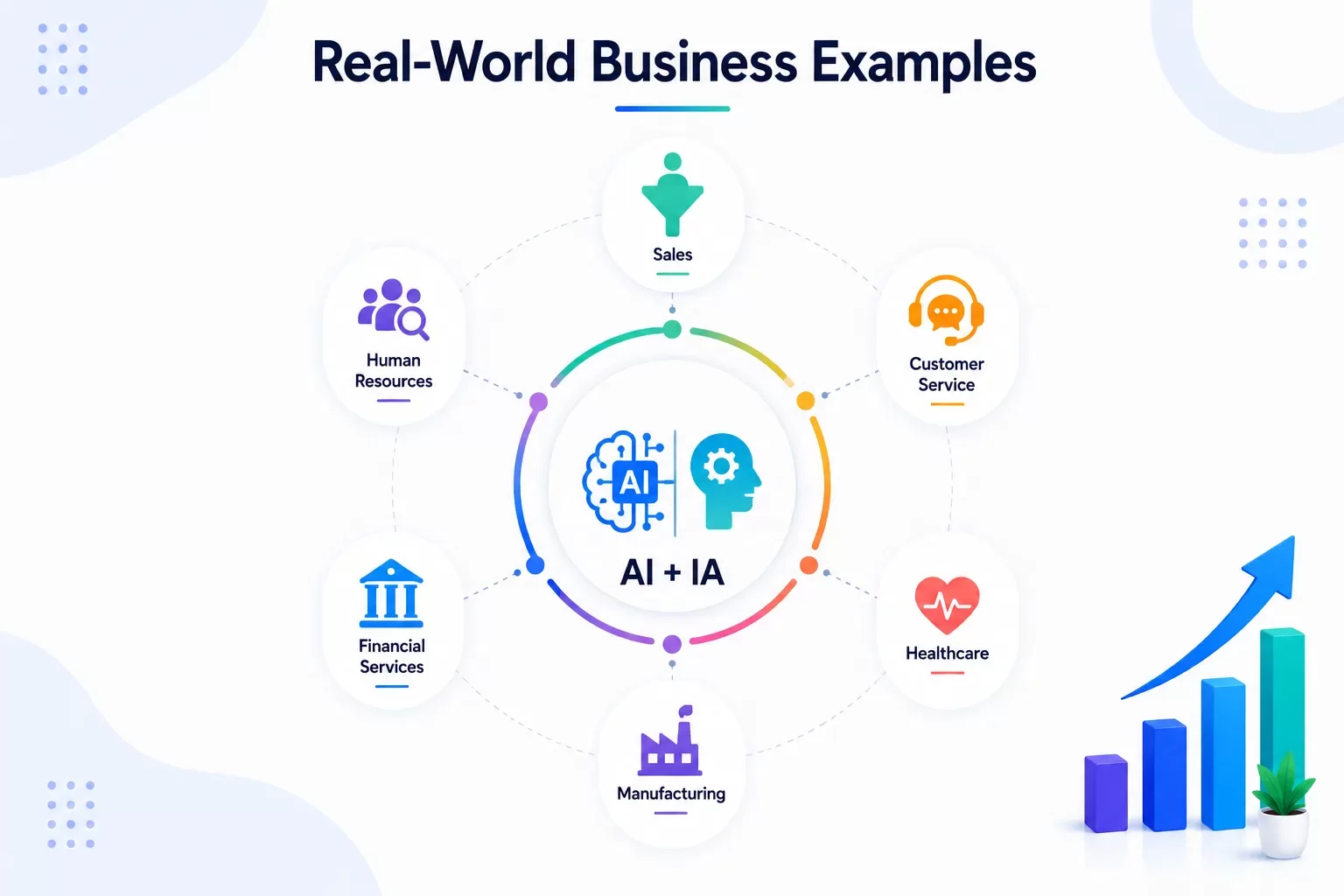
Real-World Business Examples
Sales
AI automatically scores leads, sends follow-up emails, schedules appointments, and predicts revenue. IA recommends the next best action, summarizes customer meetings, analyzes buying signals, and helps sales representatives prepare for negotiations. Together, they enable sales professionals to spend more time building relationships instead of performing administrative tasks.
Customer Service
AI-powered chatbots answer common questions around the clock. When conversations become more complex, IA provides support agents with customer history, recommended responses, sentiment analysis, and relevant knowledge articles. Customers receive faster service while still benefiting from human empathy when it matters most.
Healthcare
Artificial Intelligence can analyze thousands of medical images in seconds and detect abnormalities that might otherwise be overlooked. Intelligence Augmentation helps physicians review those findings, compare treatment options, assess patient history, and make final clinical decisions. This combination improves diagnostic accuracy while maintaining physician oversight.
Manufacturing
AI continuously monitors equipment performance to predict maintenance requirements before failures occur. IA helps plant managers prioritize maintenance schedules, allocate resources efficiently, and understand the operational impact of downtime. The result is increased equipment reliability and better production planning.
Financial Services
Banks increasingly use AI to detect fraudulent transactions, automate compliance checks, and identify unusual account activity. Financial advisors use IA to analyze investment opportunities, evaluate risk profiles, and provide personalized recommendations to clients. Automation handles the repetitive work while professionals focus on strategic financial planning.
Human Resources
AI screens resumes, schedules interviews, and identifies candidates whose qualifications align with job requirements. IA assists recruiters by highlighting cultural fit indicators, recommending interview questions, summarizing candidate strengths, and identifying potential concerns before hiring decisions are made. Recruiters remain responsible for selecting the right individual while benefiting from richer insights.
Can AI and IA Work Together?
Absolutely. In fact, the most successful organizations rarely choose between AI and IA—they combine both.
Imagine a modern CRM platform. AI automatically captures leads from multiple channels, enriches contact information, scores opportunities, generates follow-up emails, schedules appointments, and updates records. Meanwhile, IA recommends which opportunities deserve immediate attention, identifies accounts at risk of being lost, summarizes customer conversations, suggests negotiation strategies, and alerts sales managers when intervention may be needed.
The AI performs the repetitive work. The IA empowers the sales team to make better decisions. This partnership between automation and human expertise often produces significantly better results than either technology alone.
Choosing the Right Approach
Before implementing any intelligent technology, business leaders should evaluate several questions:
- Is the process repetitive and rule-based?
- Does the decision require creativity or empathy?
- What is the cost of making an incorrect decision?
- Will customers expect human interaction?
- Can automation improve speed without reducing quality?
- Where does human expertise create competitive value?
Processes involving predictable, repetitive work typically benefit from AI. Processes involving strategy, negotiation, collaboration, ethics, or customer relationships usually benefit from IA. Many organizations ultimately discover that their greatest opportunity lies in combining both approaches throughout the customer journey.
The Future of Business Intelligence
The conversation is no longer about whether businesses should adopt AI. The real question is how organizations will combine artificial intelligence with human intelligence to create exceptional customer experiences and stronger business outcomes.
Future workplaces will increasingly rely on intelligent systems that automate routine work while empowering employees to focus on innovation, creativity, relationship building, and strategic thinking. Employees will spend less time entering data, searching for information, or completing repetitive administrative tasks. Instead, they'll use intelligent recommendations, predictive analytics, and real-time insights to solve higher-value problems.
Organizations that embrace this collaborative model will likely outperform competitors focused solely on automation.
Final Thoughts
Artificial Intelligence and Intelligence Augmentation are not competing technologies—they are complementary strategies. AI excels at speed, automation, consistency, and processing massive amounts of information. IA excels at enhancing human expertise, improving decisions, and preserving the qualities that make people uniquely valuable.
Businesses don't win simply by replacing people with technology. They win by enabling people to perform at their highest potential while allowing intelligent systems to handle repetitive work.
As digital transformation continues to reshape every industry, the organizations that balance automation with human intelligence will be the ones best positioned for long-term success.
Rather than asking whether your business needs AI or IA, ask a better question: How can technology empower our people while automating the work that doesn't require them? The answer to that question will shape the future of your business far more than adopting AI alone.