 Log in
 Start Free Trial
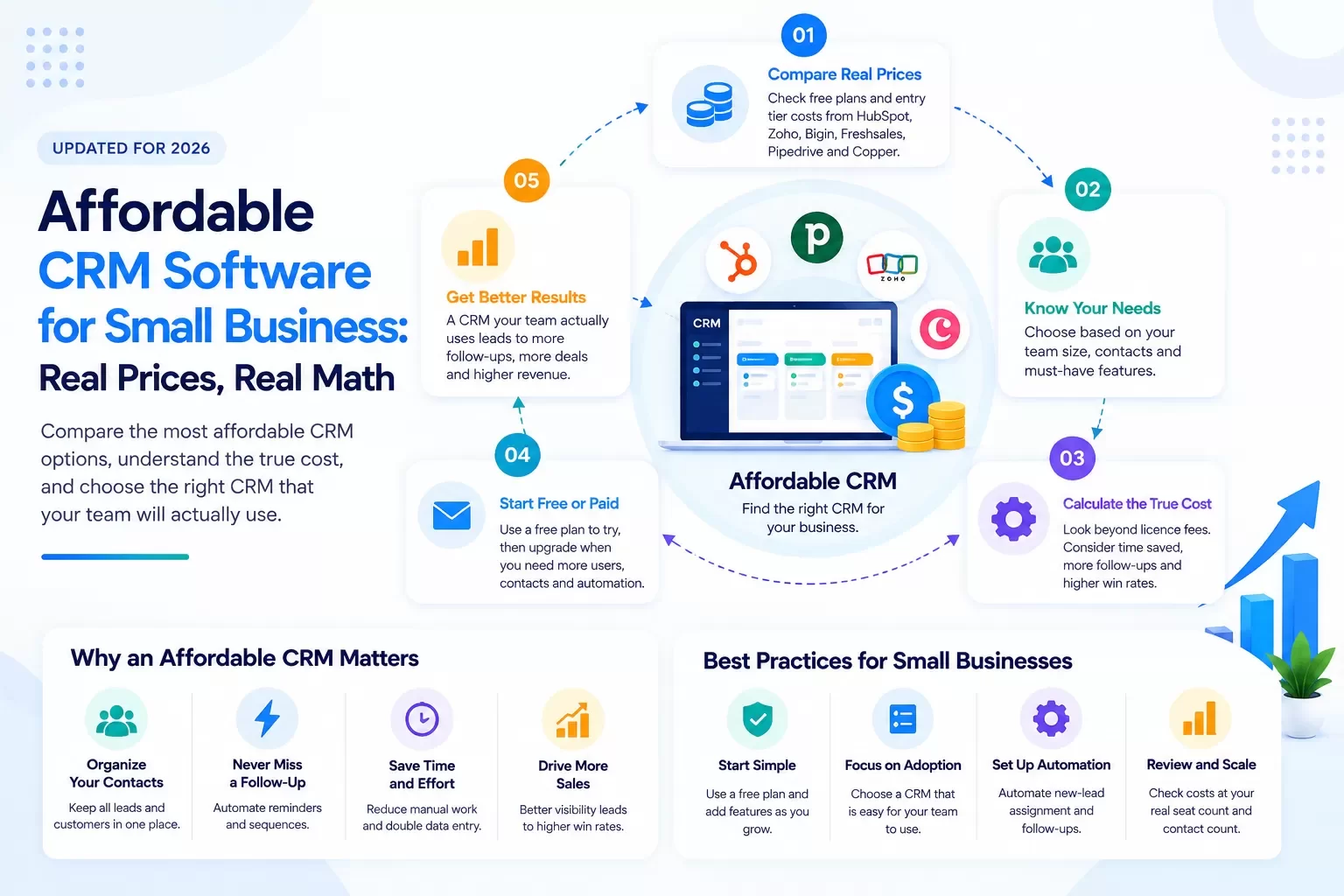
What are the cheapest CRMs for small business in 2026?
Every price below comes from the vendor's own pricing page, as of Sep 2026.
| CRM | Free plan | Cheapest paid tier (annual billing) | Monthly billing | Watch for |
|---|---|---|---|---|
| HubSpot Sales Hub | Free for up to 2 users, 1,000 contacts (hubspot.com/pricing/crm) | Starter $7/seat/mo | $20/seat/mo | Professional jumps to $90/seat/mo annual + $1,500 onboarding |
| Zoho CRM | Free for 3 users | Standard [CONFIRM price in USD] | [CONFIRM] | More setup to unlock its depth |
| Bigin by Zoho CRM | Free, 1 user, 500 records | Express $7/user/mo | $9/user/mo | Built for simple pipelines; 50,000-record cap on Express |
| Freshsales | No free plan listed; 21-day trial | Growth $9/user/mo | [CONFIRM monthly price] | Pro tier is $39/user/mo annual |
| Pipedrive | No free plan; 14-day trial | Lite $14/seat/mo | [CONFIRM monthly price] | Automation depth grows on Growth ($39) and above |
| Copper | Free trial | Basic $23/seat/mo | $29/seat/mo | Built for Google Workspace; 2,500-contact cap on Basic |
Sources linked in each row, as of Sep 2026.
Free vs. paid CRM: which should a small business choose?
Free CRMs are a real option. They are not a trap. But they are designed to be outgrown.
A free CRM is enough when:
- You have 1-3 people selling.
- Your contact list is small (think hundreds, not thousands).
- You mainly need a shared contact list and a basic pipeline.
You'll want paid when:
- Follow-ups need to happen automatically, not from memory.
- You need more users, more contacts or more pipelines.
- You want reporting you trust for forecasting.
- Meetings, proposals and email history must live on the deal.
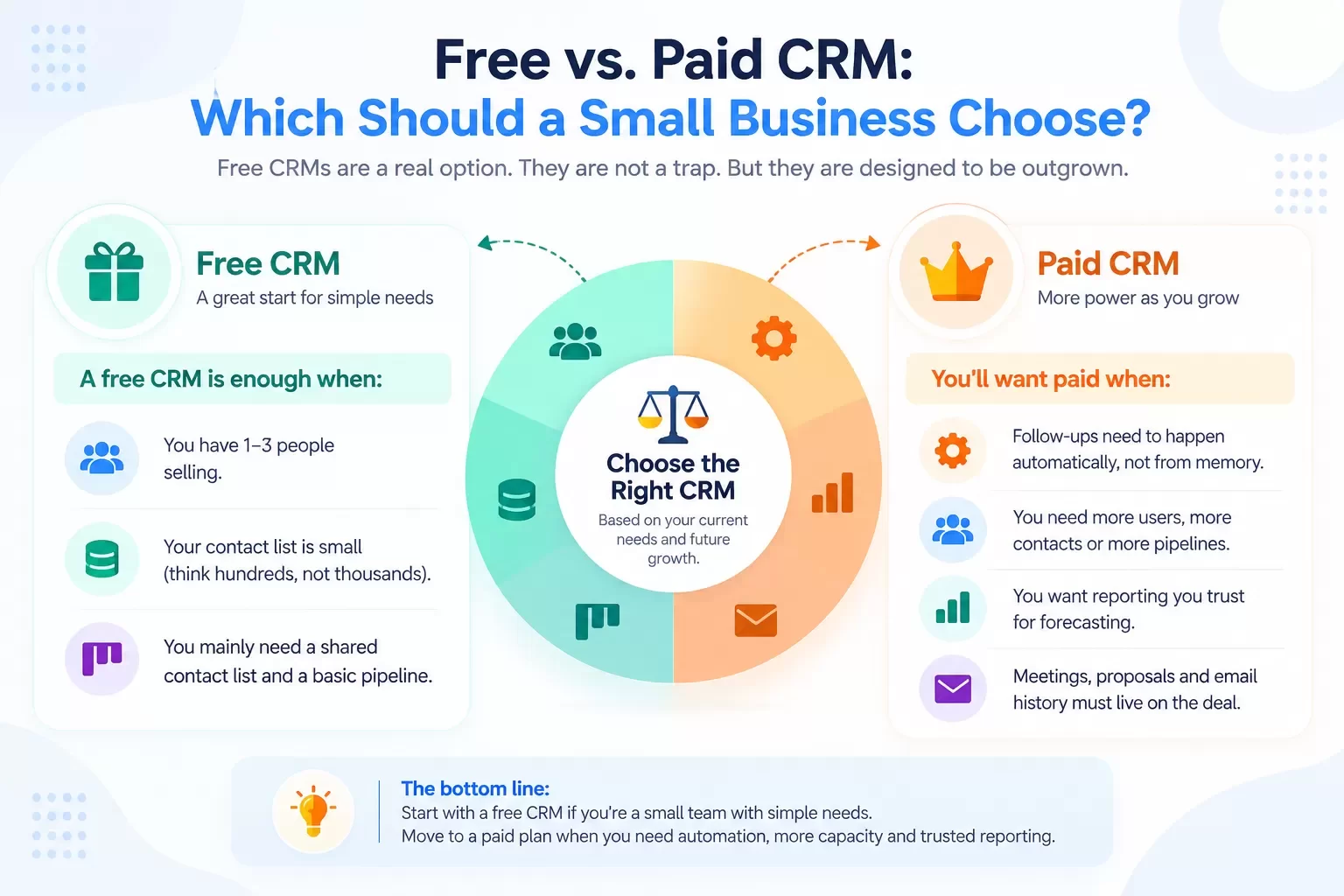
The hidden cost of free: the upgrade path. Check what the next tier costs at your team size before you commit. On HubSpot, for example, the jump from Starter to Professional is $7 to $90 per seat per month on annual billing, plus a one-time $1,500 onboarding fee (hubspot.com, Sep 2026).
Is the cheapest CRM actually the cheapest?
No. The cheapest CRM is the one your team actually uses.
Here is why. A CRM's licence is usually the smallest cost on the page. The big costs are:
- Leads that never get a follow-up because the system didn't remind anyone.
- Hours spent re-entering data in the CRM, the spreadsheet and the inbox.
- Deals you can't forecast because half the pipeline is stale.
- The second migration when you outgrow the first tool in a year.
What does a CRM nobody uses really cost?
Example (hypothetical numbers): a 5-person roofing contractor
The owner picked a free CRM. Reps found it clunky and kept working bids from their phones and a shared spreadsheet.
| Cost line | Assumption | Monthly cost |
|---|---|---|
| CRM licence | Free tier | $0 |
| Duplicate data entry | 5 reps x 3 hrs/week x 4.33 weeks x $35/hr | $2,273 |
| Missed bid follow-ups | 40 bids/mo, 20% get no follow-up = 8; 25% would have closed = 2 jobs x $12,000 | $24,000 |
| Owner chasing status | 4 hrs/week x 4.33 weeks x $75/hr | $1,299 |
| Total monthly cost of "free" | $27,572 |
Now flip it. A paid CRM that the team adopts - even at $50 per user per month, $250/month for five - only needs to save one of those two lost jobs to pay for itself many times over.
Try the math with your own numbers in the Arches lead cost and campaign ROI calculators [CONFIRM: calculators live + URLs].
What makes a small team actually use a CRM?
Adoption isn't about training. It's about how much work the CRM removes versus adds. Look for:
- Two-minute test. A new rep can log a call, move a deal and set a follow-up in under two minutes.
- Email and calendar that log themselves. If reps must copy things in, they won't.
- A clear next action on every deal. Who does what, by when.
- Automatic follow-up. When a prospect goes quiet, the system acts.
- Mobile that works in the field. Roof, jobsite, showing, service call.
- One place, not five. Leads, conversations, meetings, proposals and follow-ups together.
Where does Arches CRM fit?
Arches CRM is built around one idea: Sales Made Simple. Capture every lead. Keep every conversation. Capture every meeting. Know the next action. Create the proposal. Follow up automatically. Close the deal.
It is designed to pass the two-minute test and to remove work rather than add it. Pricing: [CONFIRM price]. Free trial: [CONFIRM: trial length].
The AI moment
A roofing sales rep finishes an inspection and speaks a quick voice note: "Hail damage on the north slope, owner wants a quote before Friday, insurance adjuster coming Tuesday." Arches turns it into structured deal notes, sets a task to send the quote by Thursday, drafts the follow-up email to the homeowner, and adds a reminder for the day after the adjuster visit [CONFIRM: voice note capture + AI task/email drafting live]. The rep taps send and drives to the next job.
Vertical scenario: an HVAC company's post-job review and referral loop
Small service businesses win on referrals. Most lose them to silence after the job. Here is a simple loop any CRM should run automatically:
| Day | Trigger | Automatic action |
|---|---|---|
| 0 | Job marked complete | Thank-you text/email with invoice link |
| 1 | No issue reported | Review request with direct link |
| 7 | Review left | Referral ask: "Know a neighbor who needs a tune-up?" |
| 7 | No review | One gentle reminder |
| 180 | Six months since service | Maintenance plan offer + seasonal tune-up booking |
| 365 | Anniversary | Filter/inspection reminder; upsell check |
Example (hypothetical numbers): 60 completed jobs a month, a 10% referral rate from the loop = 6 referred leads. At a 40% close rate and $450 average service ticket, that is about $1,080/month in new service revenue - before any install upsells. The loop costs nothing to run once it's built.
How do you choose an affordable CRM in one afternoon?
- Write down your real numbers: users now, users in 12 months, contacts, leads per month.
- Price the next tier, not just the entry tier, at your 12-month size.
- Run the two-minute test with your least technical rep.
- Build one follow-up automation in the trial. If you can't, neither will your team.
- Calculate the cost of a missed follow-up using the table above.
- Pick the one your team will use.
FAQ
What is the best free CRM for small business?
HubSpot is free for up to 2 users and 1,000 contacts; Zoho CRM is free for 3 users; Bigin by Zoho has a free single-user plan with 500 records - per each vendor's site, as of Sep 2026. The best one is the one your team will open every day.
What is the cheapest paid CRM?
On annual billing as of Sep 2026: Bigin Express and HubSpot Starter at $7/user/month, Freshsales Growth at $9, Pipedrive Lite at $14 and Copper Basic at $23.
Is a free CRM good enough?
For 1-3 sellers with a simple pipeline, often yes. Once you need automatic follow-ups, more users or reliable forecasting, you'll likely need a paid tier.
Why do small businesses stop using their CRM?
Because it adds work instead of removing it: manual data entry, no automatic follow-up, and tools split across inbox, spreadsheet and phone.
How much should a small business spend on a CRM?
Start from the value of one closed deal. If a CRM helps you close one more job a month, most paid tiers pay for themselves.
Does Arches CRM have a free plan?
Arches offers a free trial [CONFIRM: free trial vs free plan, and length].
Internal-link suggestions
- Keap Alternatives 2026: Pricing, ROI and Better Fits
- SugarCRM Alternatives: Scorecard, 3-Year TCO and a Migration Plan
- Copper CRM Alternatives for Gmail and Outlook Teams
LinkedIn teaser
Free CRMs are real - but in our worked example, a CRM nobody uses costs a 5-person roofer $27,000+ a month. Here are the real prices and the real math.
Start simple
Small team? Start your free trial of Arches CRM and put every lead, meeting and follow-up in one place.
100+ employees? Book a demo and we will run the adoption and ROI math with your team.